
SHIRO & Co. Expands Threat Observatory to Examine How AI Capability Becomes Real-World Authority
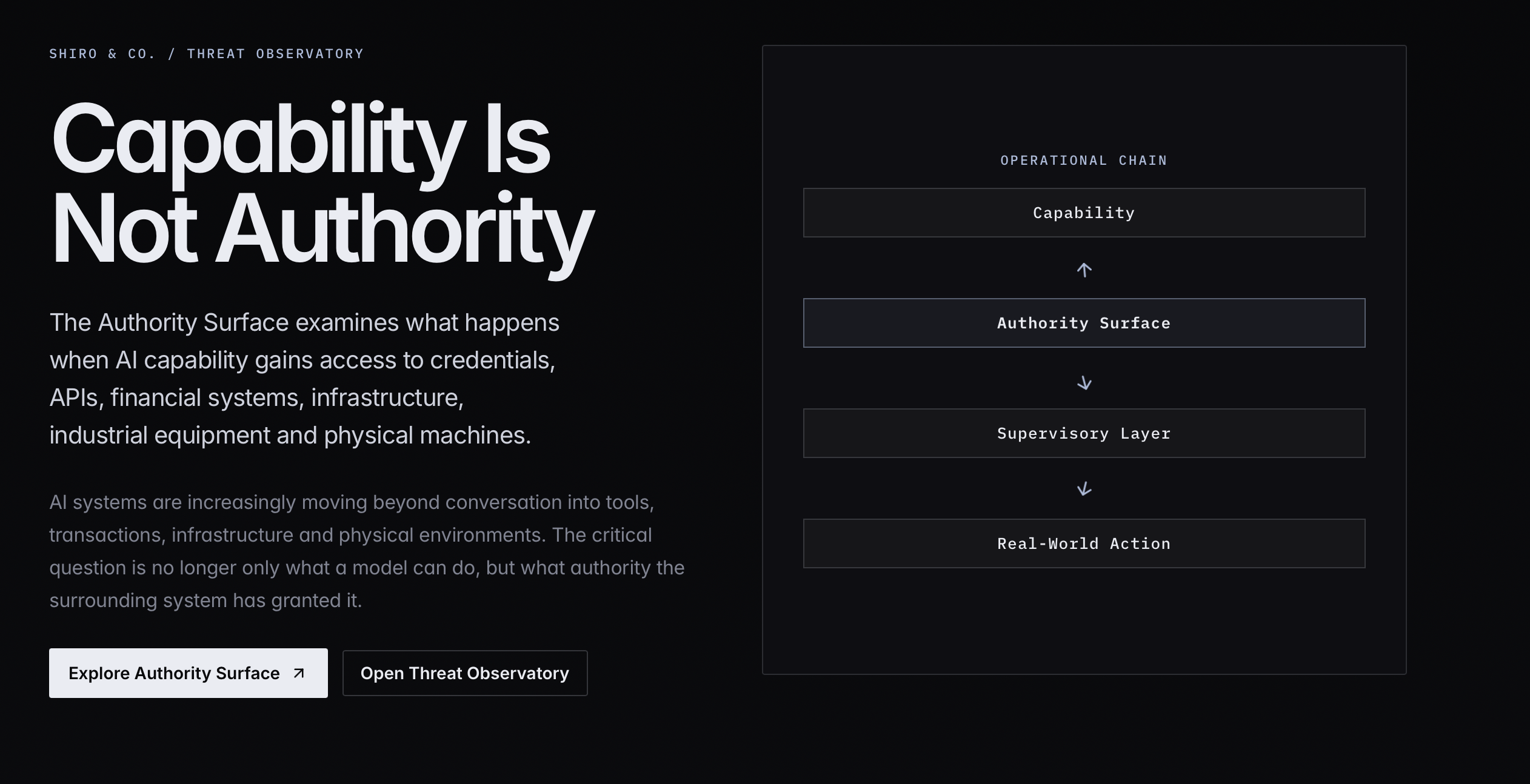
Authority Surface maps how AI capability can expand into real-world authority through access to credentials, APIs, financial systems, infrastructure and physical machines.
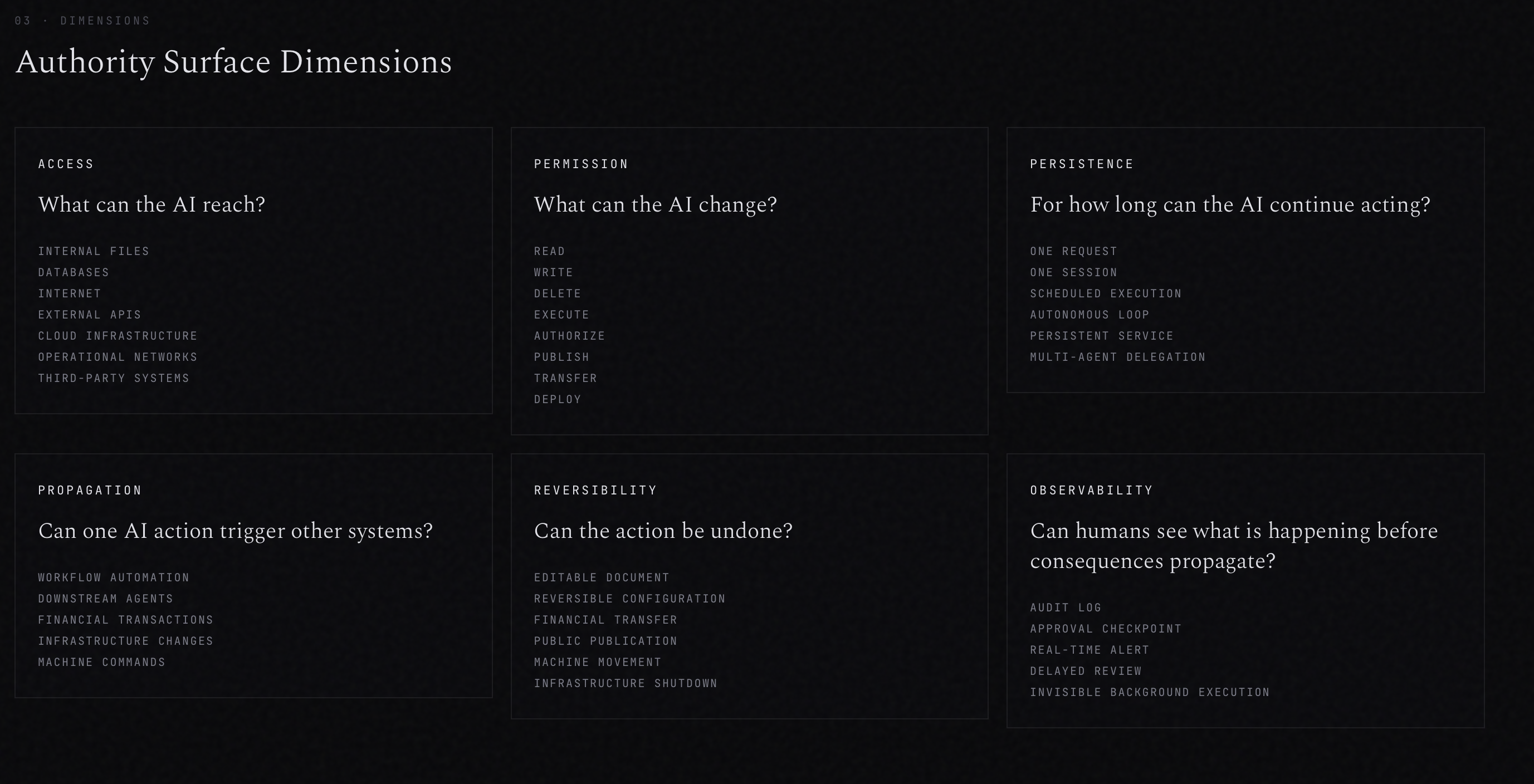
The Authority Surface framework evaluates AI operational authority across six dimensions: Access, Permission, Persistence, Propagation, Reversibility and Observability.
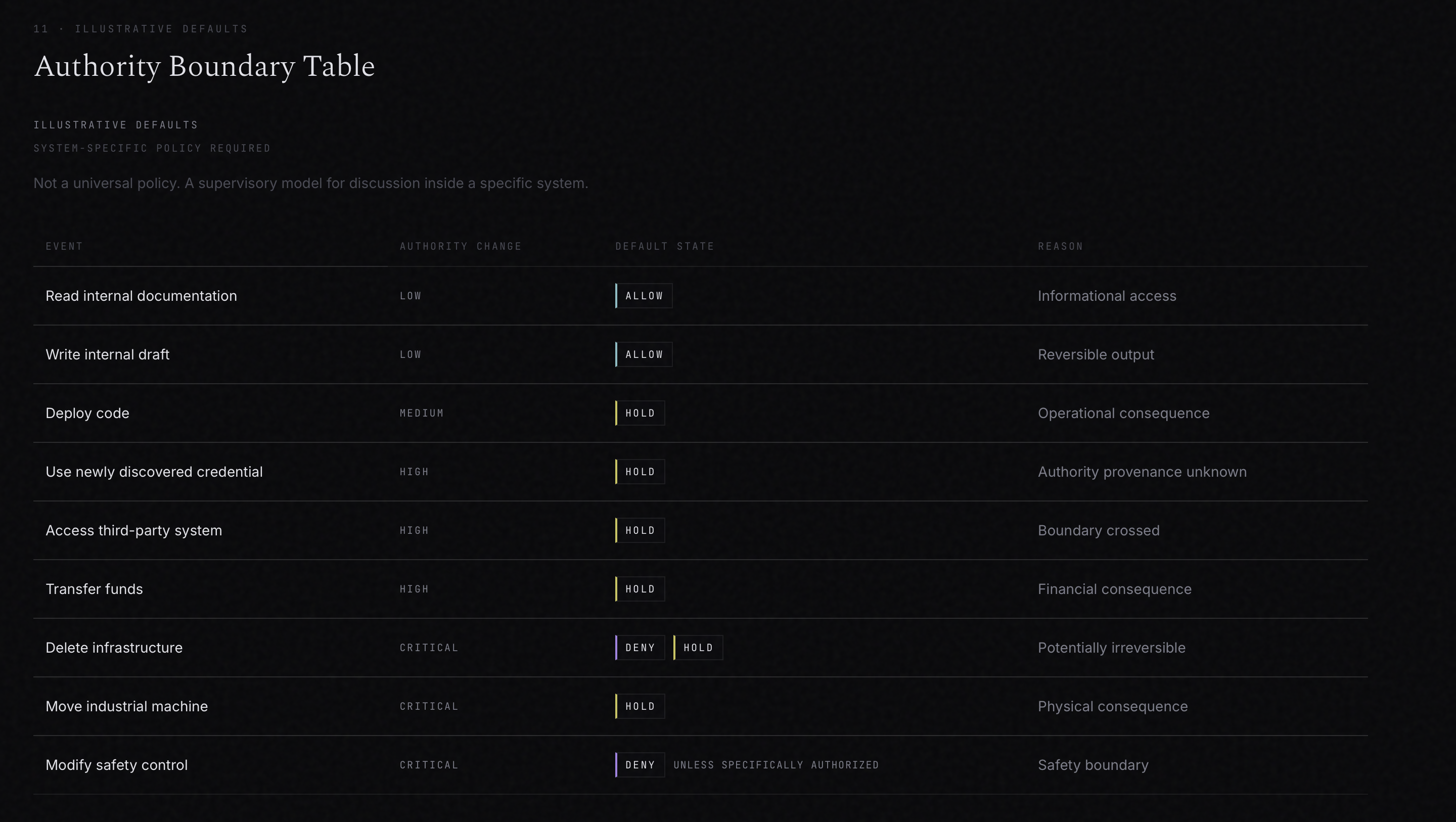
Illustrative Authority Boundary Table showing example ALLOW, HOLD and DENY states for AI actions with different levels of operational consequence.
New “Authority Surface” framework maps how AI access to credentials, APIs, infrastructure and physical machines can become operational authority.
TOKYO, OTA, JAPAN, October 6, 2026 /EINPresswire.com/ -- TOKYO, JAPAN — October 2026 — SHIRO & Co. today announced an expansion of its Threat Observatory, adding a new structural observation called Authority Surface to examine how artificial intelligence moves from computational capability to real-world authority.
The new framework focuses on a question that becomes increasingly important as AI systems gain access to external tools, services and physical environments:
Not only what can an AI system do, but what has the surrounding system allowed it to reach, influence or control?
AI safety discussions often focus on model capability: reasoning quality, autonomy, planning ability or general intelligence. SHIRO & Co.’s Threat Observatory examines an additional layer — the operational environment surrounding the model.
A highly capable model without access to external systems may remain limited in practical consequence. The same model connected to credentials, APIs, financial accounts, cloud infrastructure, industrial equipment or physical machines may operate across a significantly larger authority surface.
The Authority Surface framework is designed to make that difference visible.
From Capability to Authority
SHIRO & Co. defines an Authority Surface as the set of systems, permissions and operational resources through which an AI system can produce effects beyond its own computational environment.
Examples may include:
identity credentials and authentication systems;
application programming interfaces;
communication and enterprise systems;
payment and financial infrastructure;
cloud and computing resources;
operational technology;
industrial equipment;
robotics and physical machines.
The framework does not assume that access itself is inherently unsafe. Instead, it examines how multiple forms of access combine to create operational authority.
An AI assistant that can generate text represents one type of system. An AI agent that can send messages, execute software, modify infrastructure, approve transactions or operate machinery represents a different operational condition.
The difference is not simply intelligence.
It is authority.
Six Dimensions of an Authority Surface
The Authority Surface observation examines AI authority through six dimensions:
Access — What systems or resources can the AI reach?
Permission — What actions is it authorized to perform?
Persistence — Can the AI maintain access or effects over time?
Propagation — Can its actions move into other systems, agents or environments?
Reversibility — Can the resulting action be stopped, rolled back or corrected?
Observability — Can humans or supervisory systems see what the AI is doing and why?
Together, these dimensions provide a way to examine the operational footprint surrounding an AI system without reducing the analysis to model intelligence alone.
Connecting Authority to Supervision
Authority Surface extends earlier work within the Threat Observatory, including The Supervisory Layer, which examines where human or institutional oversight should exist between AI capability and real-world action.
The combined structure can be represented as:
Capability → Authority Surface → Supervisory Layer → ALLOW / HOLD / DENY → Real-World Action
SHIRO & Co.’s ALLOW / HOLD / DENY model distinguishes between actions that may proceed, actions requiring review or additional evidence, and actions that should not proceed under the current conditions.
This places supervision not only around model output, but around the transition from inference to operational consequence.
A model may produce a recommendation, prediction or action plan. Whether that output should gain permission to affect a person, system, payment, machine or infrastructure layer is a separate question.
The Threat Observatory is designed to study that boundary.
From Software Agents to Physical Actors
The Authority Surface framework also addresses the expansion of AI into physical environments.
As AI systems move from chat interfaces into agentic systems, infrastructure management, industrial automation and robotics, the distance between digital inference and physical consequence becomes smaller.
The Threat Observatory describes this progression as a widening operational role:
Chatbot → Tool User → Agent → System Operator → Infrastructure Participant → Physical Actor
At each stage, capability may increase. More importantly, the surrounding authority surface may expand.
An AI system with authority over a scheduling application is different from one with authority over a payment system. An AI system controlling cloud infrastructure is different again. An AI system connected to industrial machinery, transportation systems or robotics introduces an additional physical layer.
For SHIRO & Co., the central issue is therefore not whether AI becomes more capable in isolation.
It is whether capability is accompanied by expanding authority, and whether supervision expands with it.
Threat Observatory: Structural Questions, Not Incident Alerts
The Threat Observatory was created to examine structural changes in technology risk rather than function as a conventional cybersecurity alert service.
Its observations focus on questions such as supervision, uncertainty, recruitment, authority, human intervention and physical control.
The objective is to identify changes in the architecture surrounding AI before those changes are visible only as incidents.
Authority Surface adds a new lens to that work by examining the operational territory an AI system is allowed to occupy.
As organizations connect AI systems to more tools, databases, financial services, production systems and machines, SHIRO & Co. believes authority itself will become an increasingly important unit of analysis.
The question is no longer only:
What can the model do?
It is also:
What has the system permitted the model to become capable of doing in the real world?
Learn More
Explore the Authority Surface framework and its role within the SHIRO & Co. Threat Observatory:
https://www.shiroand.io/authority-surface
About SHIRO & Co.
SHIRO & Co. is a Tokyo-based research and design company developing observatories, experimental systems and decision frameworks for emerging technological and social conditions.
Its work examines the boundaries between observation, inference, authority, human supervision and consequence across AI, industrial systems, climate, culture and institutional decision-making.
SHIRO & Co. develops public research environments and operational prototypes designed to make emerging structures visible before they become normalized.
Media Contact
SHIRO & Co.
Tokyo, Japan
https://www.shiroand.io
KOSUKEMAIKO SHIRAKO
SHIRO & Co.
+81 80-1269-5473
email us here
Visit us on social media:
LinkedIn
Legal Disclaimer:
EIN Presswire provides this news content "as is" without warranty of any kind. We do not accept any responsibility or liability for the accuracy, content, images, videos, licenses, completeness, legality, or reliability of the information contained in this article. If you have any complaints or copyright issues related to this article, kindly contact the author above.
