

GreenTouch Supports Equipment Integration as an OEM Touch Monitor Supplier: Mounting and Interface Planning

Map the Equipment Envelope Before Selecting the Monitor
Integration planning begins by establishing physical boundaries of the host console. Internal chassis depth, sheet metal clearances, viewing angles, and operator interaction heights dictate the permissible display form factor. Physical envelope mapping also accounts for servicing ergonomics, ensuring technicians have sufficient clearance to reach fastening hardware, connect interface cables, and replace modular assemblies without dismantling the primary machine facade.
An OEM touch monitor supplier provides 2D outline drawings and 3D STEP models during layout planning. Placing high-heat power supplies directly beneath the display chassis adds unnecessary thermal loads. Reserving designated convection zones preserves uniform display temperatures and prolongs operating life.
Choose a Mounting Method That Controls AlignmentOpen-Frame Flanges for Flush Enclosures
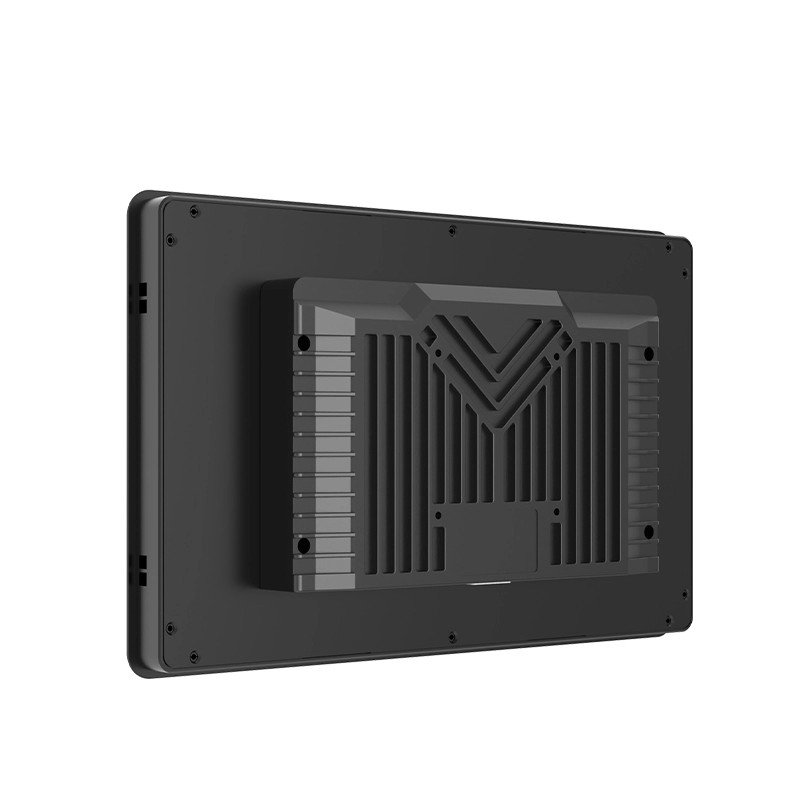
Display mounting architecture dictates structural rigidity, front-panel sealing, and visual integration, isolating the active LCD panel from torsional chassis stress. Open-frame monitors feature integrated side mounting brackets and structural metal flanges that fasten securely behind custom machine cutouts, creating a flush-front exterior surface that eliminates dirt-collecting perimeter bezels.
Flush mounting serves medical diagnostics, cleanroom automation, and food processing equipment where smooth surfaces support wipe-down sanitation. Slotted mounting holes on open-frame flanges permit dimensional micro-adjustments during cabinet assembly, compensating for slight sheet metal variations across production batches and maintaining consistent front alignment.
Rear VESA Patterns and Panel-Mount Clamping Systems
Standardized rear VESA MIS-D patterns (75x75 mm and 100x100 mm) enable mechanical installation onto articulated swing arms, internal pedestals, and modular sub-racks. Rear VESA mounting isolates the display module from host cabinet flex, protecting internal glass layers from torsional mechanical distortion. For sealed NEMA or IP65 electrical enclosures, panel-mount architectures utilize perimeter threaded studs or rear clamping brackets that draw the monitor front bezel firmly against the cutout, compressing an elastomeric gasket to form a watertight seal against airborne particulates and liquid washdowns.
Check Port Direction and Cable Bend Space
Connector orientation and internal cabling volume represent critical integration details. Straight-back rear connectors require substantial clearance behind the chassis for rigid cable boots. Excessive cable bending stresses internal circuit boards, causing cracked solder joints and signal loss over operating lifecycles.
Selecting monitors engineered with downward-facing or recessed side-facing I/O ports minimizes required enclosure depth and facilitates vertical cable routing. Internal cable paths must respect minimum bend radius standards. Standard high-speed digital video cables require a dynamic bend radius of at least four to six times the outer cable diameter to preserve high-frequency impedance and signal integrity.
Securing interface connections against mechanical vibration is another essential integration requirement. Machinery with rotating spindles or hydraulic pumps transmits continuous vibration through the chassis. Specifying locking screw flanges on VGA and DVI ports alongside captive jack screws on USB connectors prevents accidental disconnections during factory operation.
Separate Video, Touch, and Power Paths
Industrial machinery consoles house sources of electromagnetic interference, including variable frequency motor drives, high-current switching contactors, and high-voltage power converters. Unshielded signal lines routed near power cables suffer from inductive coupling. High-speed digital video streams, low-voltage touch digitizer signals, and direct-current power buses demand isolated conduits to prevent cross-talk and transient noise induction.
Isolating Touch Telemetry from High-Current Switching Noise
Touch digitization relies on low-voltage signals. Routing USB or RS-232 touch lines in parallel with AC mains wiring introduces common-mode electrical noise, causing coordinate jitter, cursor drift, and false touches. Designers route touch telemetry through metallic conduits, using double-shielded cables and ferrite suppressors to attenuate high-frequency noise spikes.
Star Grounding and Digital Video Signal Integrity
Digital video transmission protocols like HDMI and DisplayPort require precise differential impedance matching. Ground loops between the host controller and the display chassis induce video tearing, horizontal lines, and synchronization drops. Implementing a dedicated star-grounding architecture ensures that the display chassis, touch controller, and host computer share an identical low-impedance ground potential, eliminating circulating ground currents.
Design for Cooling and Service Access
Thermal management directly affects operational reliability and optical lifespan of industrial display backlights. High ambient factory temperatures combined with heat generated by internal power converters elevate internal cabinet temperatures beyond safe component limits, accelerating luminous decay and color shifting in environments exceeding 50°C.
Convection airflow channels or conduction-cooled aluminum chassis dissipate heat away from the liquid crystal layer. Designers position serviceable items, such as backlight inverter fuses and OSD buttons, for access through rear doors.
High-conductivity silicone gap pads bridge timing controller ICs and the aluminum back chassis, directing heat away from semiconductors for reliable 24/7 operation.
Validate the Assembly with a Controlled Sample
Equipment integration concludes with empirical validation using representative production-intent samples. Engineering teams evaluate mechanical fit, electrical compatibility, and thermal behavior within the actual production chassis prior to volume manufacturing sign-off. GreenTouch fabricates evaluation samples using verified production tooling, ensuring CAD models align directly with actual sheet metal cutouts, bracket bend radii, and connector clearances during trial assembly.
Conducting pilot assembly builds confirms that wiring harnesses mate cleanly without strain and that perimeter gaskets compress uniformly to maintain ingress seals. Environmental stress screening of the assembled equipment, including thermal chamber cycling, continuous full-load electrical burn-in, and operational vibration testing, identifies resonance vulnerabilities or thermal hotspots before volume manufacturing begins.
FAQ about OEM Touch Monitor Integration
Engineering teams and equipment builders regularly evaluate these technical questions during hardware integration planning.
How Does an Open-Frame Architecture Simplify Machine Assembly?
Open-frame monitors feature bare metal structural flanges that mount flush behind custom machine cutouts. This architecture eliminates external plastic bezels, allowing equipment builders to create flat, dust-resistant front facades that match their machine design.
What Thermal Clearance Is Necessary for Fanless Monitor Enclosures?
Fanless industrial monitors require at least 30 to 50 mm of unobstructed convection airspace around rear heat-dissipation fins. In sealed enclosures, internal metal brackets can be thermally coupled to the host chassis to conduct heat away.
Can Dual Touch Interfaces Operate Concurrently on One Display?
Industrial controllers typically provide either USB HID or RS-232 serial communication. While both physical connectors may be present on the monitor I/O panel, the digitizer operates over one active protocol at a time to prevent coordinate data collisions.
Submit the Equipment Drawing for Integration Review
Optimizing touch monitor integration requires early collaboration between equipment designers and display engineering specialists. Harmonizing mounting geometries, signal interfaces, power architectures, and environmental protection at the initial concept stage prevents costly assembly modifications and accelerates market deployment. Equipment manufacturers, system integrators, and industrial automation engineers can share their project specifications and mechanical models directly at https://www.greentouch.com.cn/ for technical evaluation. The engineering team provides production planning, factory inspections, and mechanical integration guidance for complex machinery.
ShenZhen GreenTouch Technology Co.,Ltd.
GreenTouch
email us here
Visit us on social media:
LinkedIn
Facebook
YouTube
Legal Disclaimer:
EIN Presswire provides this news content "as is" without warranty of any kind. We do not accept any responsibility or liability for the accuracy, content, images, videos, licenses, completeness, legality, or reliability of the information contained in this article. If you have any complaints or copyright issues related to this article, kindly contact the author above.
