

A Recent BJOG study Explores If Genetic Testing of the Embryo Improve IVF Outcomes
A clinical trial analysis suggests that embryo genetics may not be the primary cause of implantation failure in young women
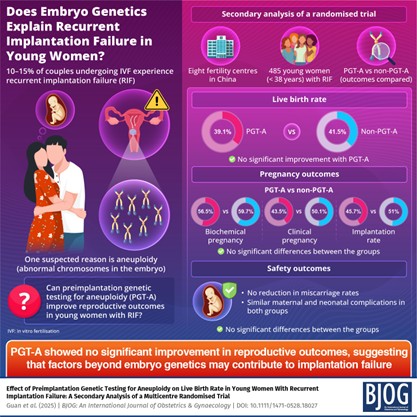
CHINA, September 14, 2026 /EINPresswire.com/ -- Recurrent implantation failure (RIF) remains a major challenge for patients undergoing in vitro fertilization. In a secondary analysis of a large clinical trial, researchers investigated whether preimplantation genetic testing for aneuploidy (PGT-A) in embryos could improve reproductive outcomes in women suffering from RIF. The results revealed that PGT-A did not increase live birth or pregnancy rates, suggesting that biological factors beyond embryo genetic abnormalities may influence implantation success in young women.In vitro fertilization (IVF) is helping millions of couples across the world to conceive and start a family. Yet many patients still face repeated implantation failures despite multiple clinical efforts. One possible cause often considered by clinicians is aneuploidy, or abnormalities in the number of chromosomes in an embryo. However, the clinical value of screening embryos using preimplantation genetic testing for aneuploidy (PGT-A) continues to be debated, particularly among younger women, who generally have higher rates of chromosomally normal embryos.
To evaluate whether PGT-A improves outcomes in this population, researchers led by Dr. Yun Sun from the Department of Reproductive Medicine, Ren Ji Hospital, Shanghai Jiao Tong University School of Medicine, China, also affiliated with the Shanghai Key Laboratory for Assisted Reproduction and Reproductive Genetics, China, along with fellow researchers from Ren ji Hospital, the Shanghai Key Laboratory for Assisted Reproduction and Reproductive Genetics, China, and the Department of Obstetrics and Gynecology, Baylor Scott & White, USA, conducted a secondary analysis of data acquired from a large multicenter clinical trial that was carried out across eight fertility centres in China between 2018 and 2020. The findings were made available online on December 16, 2024, and were published in Volume 132, Issue S2 of the journal BJOG: An International Journal of Obstetrics & Gynaecology on April 15, 2025.
“We analysed data from more than 485 women under the age of 38 who had a history of recurrent implantation failure even after the transfer of good-quality embryos,” explains Dr. Sun. Among these participants, 46 women had undergone PGT-A, in which embryos created using intracytoplasmic sperm injection (ICSI)—direct injection of a single sperm into the egg—were collected. These embryos were analysed using next-generation sequencing to identify chromosomally normal (euploid) embryos for transfer.
All other patients received standard IVF or ICSI care without genetic testing. After statistically matching differences between the groups, the researchers compared pregnancy outcomes after transferring a frozen-thawed blastocyst (an embryo frozen at about 5–6 days after fertilization) into the uterus of the participants.
Surprisingly, the results showed no significant benefit of PGT-A. The number of successful births was similar in both groups, showing no meaningful differences. The rates of early pregnancy, confirmed pregnancy, successful implantation, and miscarriage were also similar between the groups. Moreover, the analysis found that genetic testing did not reduce miscarriage rates or improve health outcomes for mothers or babies.
Additional analysis showed that PGT-A did not improve the likelihood of live birth, indicating that non-genetic factors, including endometrial conditions and embryo–uterus interactions, may be more important in implantation failure in younger women.
Reflecting on these results, Dr. Sun comments, “Although PGT-A can be beneficial for some patients, its routine use in younger women with recurrent implantation failure should be carefully evaluated.” Since younger patients typically produce a higher number of chromosomally normal embryos, additional embryo testing may not translate into improved clinical outcomes.
While the study provides important insights into the role of genetic embryo testing in younger patients undergoing IVF, the authors acknowledge several limitations, including the relatively small number of women who underwent PGT-A and the non-randomized use of genetic testing in the original trial. They emphasize that further research is needed to better understand the underlying causes of implantation failure and to develop more personalized fertility treatment approaches.
***
Reference
Title of original paper: Effect of Preimplantation Genetic Testing for Aneuploidy on Live Birth Rate in Young Women with Recurrent Implantation Failure: A Secondary Analysis of a Multicentre Randomised Trial
Journal: BJOG: An International Journal of Obstetrics & Gynaecology
DOI: 10.1111/1471-0528.18027
About Renji Hospital, Shanghai Jiao Tong University School of Medicine, China:
Founded in 1844, Renji Hospital is one of the oldest Western medicine hospitals in China and a leading tertiary teaching hospital affiliated with Shanghai Jiao Tong University School of Medicine. The hospital integrates clinical care, medical education, and scientific research across multiple campuses in Shanghai. Renji is nationally recognized for expertise in disciplines such as gastroenterology, reproductive medicine, obstetrics and gynecology, and hepatobiliary surgery. With extensive research programs and international collaborations, it serves millions of outpatient and emergency visits each year and plays a key role in advancing translational medical research and specialized healthcare services in China.
Website: https://www.renji.com/en
About Dr. Yun Sun from Shanghai Jiao Tong University School of Medicine, China
Dr. Yun Sun, MD, PhD, is a senior reproductive medicine specialist with nearly three decades of clinical and research experience. She is affiliated with the Department of Reproductive Medicine Center of Renji Hospital, Shanghai Jiao Tong University School of Medicine, China. Holding a PhD in Gynecology and Obstetrics, her research focuses on assisted reproductive technologies, infertility, and IVF outcomes. She was listed among the world’s top 2% scientists in the Stanford University–Elsevier Annual Impact Ranking (2023).
Funding information
This work was supported by National Key R&D Program of China (No. 2023YFC2705500, 2023YFC2705501, 2023YFC2705503, 2023YFC2705505 and 2019YFA0802604); National Natural Science Foundation of China (No. 82130046 and 82320108009); Innovative research team of high-level local universities in Shanghai (No. SHSMU-ZLCX20210201 and SSMU-ZLCX20180401); Shanghai leading talent program; Shanghai Jiaotong University School of Medicine Affiliated Renji Hospital Clinical Research Innovation Cultivation Fund Program (RJPY-DZX-003); Science and Technology Commission of Shanghai Municipality (23Y11901400); Shanghai's Top Priority Research Center Construction Project (2023ZZ02002); and the Three-Year Action Plan for Strengthening the Construction of the Public Health System in Shanghai (No. GWVI-11.1-36 and GWVI-11.2-YQ21).
Jing Ma
Wiley
+86 10 85419367
jima@wiley.com
Legal Disclaimer:
EIN Presswire provides this news content "as is" without warranty of any kind. We do not accept any responsibility or liability for the accuracy, content, images, videos, licenses, completeness, legality, or reliability of the information contained in this article. If you have any complaints or copyright issues related to this article, kindly contact the author above.
