

Blueberry Ingredient Market to Reach USD 3.77 Billion by 2035, Growing at 6.40% CAGR
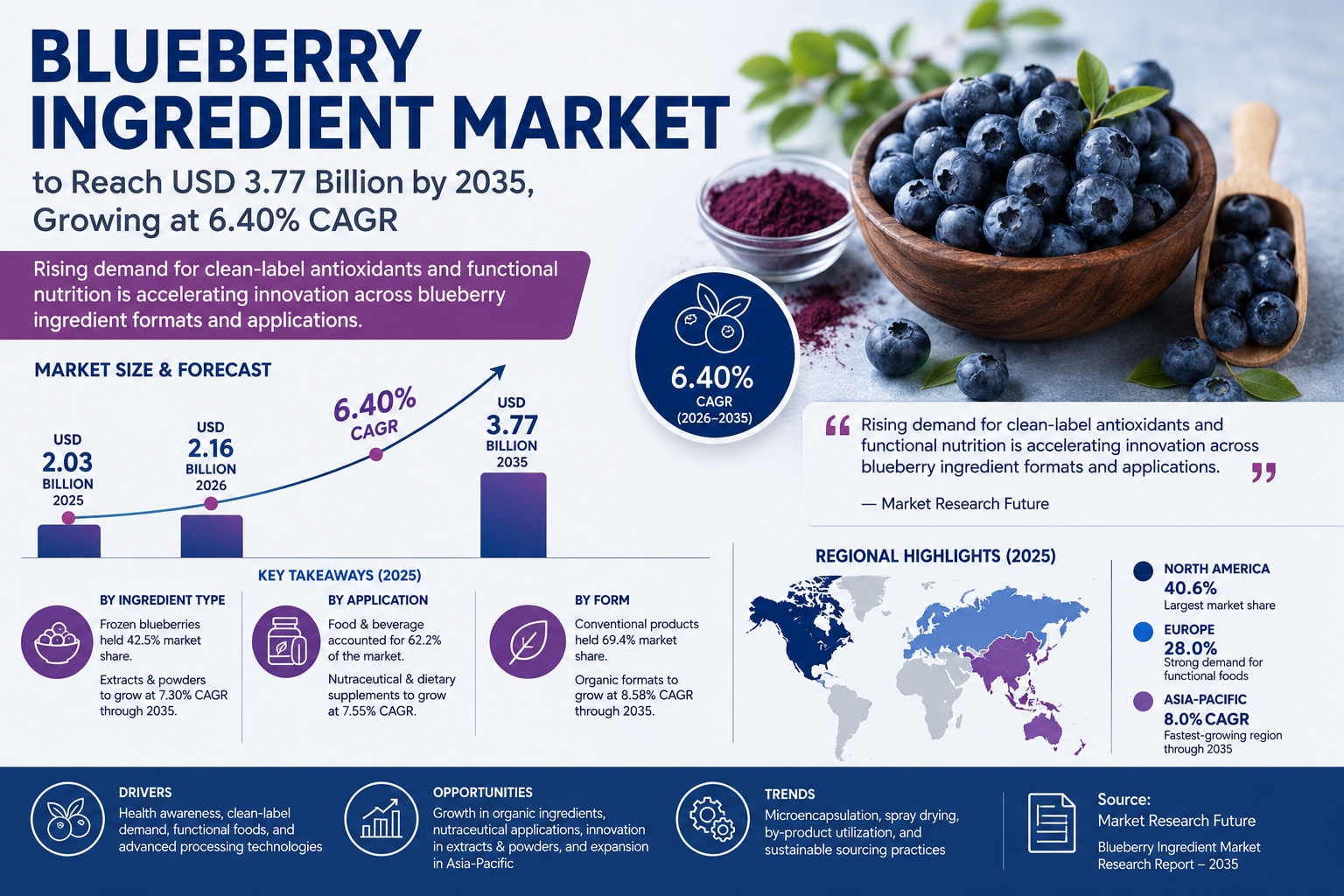
Blueberry Ingredient Market
Rising demand for clean-label antioxidants, functional foods and advanced blueberry extracts is accelerating global ingredient-market growth through 2035.
Rising demand for clean-label antioxidants and functional nutrition is accelerating innovation across blueberry ingredient formats and applications.”
NEW YORK, NY, UNITED STATES, August 20, 2026 /EINPresswire.com/ -- global Blueberry Ingredient Market is entering a sustained period of expansion as demand for plant-based antioxidants, clean-label formulations and functional nutrition continues to reshape food, beverage and nutraceutical product development. According to Market Research Future (MRFR), the market was valued at USD 2.03 billion in 2025 and is projected to increase from USD 2.16 billion in 2026 to USD 3.77 billion by 2035, representing a 6.40% compound annual growth rate (CAGR) during the forecast period from 2026 to 2035.— Market Research Future (MRFR)
The growth trajectory reflects a broader transformation in the way food manufacturers, dietary supplement companies and ingredient processors approach fruit-derived functional ingredients. Blueberries are increasingly being incorporated not only for flavor and color but also for their naturally occurring anthocyanins and antioxidant profile, creating opportunities across functional beverages, bakery products, dairy and dairy alternatives, snacks, dietary supplements, nutraceuticals, cosmetics and emerging specialty applications.
Consumer preference for recognizable, plant-derived ingredients is strengthening demand for blueberry concentrates, purées, dried formats, powders and standardized extracts. At the same time, improvements in spray drying, microencapsulation and ingredient stabilization are allowing processors to deliver blueberry-derived ingredients with longer shelf life, more consistent specifications and greater formulation flexibility.
Market Growth Supported by Clean-Label and Functional Nutrition Trends
The blueberry ingredient market is benefiting from the intersection of several major consumer and industry trends. Clean-label purchasing behavior is encouraging manufacturers to reconsider synthetic colors, artificial flavors and highly processed formulations in favor of recognizable fruit-based alternatives.
Blueberry ingredients can serve multiple formulation purposes simultaneously. Concentrates and purées can contribute fruit character and natural color, while dried blueberries and powders provide convenient formats for bakery, snacks and powdered foods. Standardized extracts and anthocyanin-rich ingredients are increasingly relevant to nutraceutical manufacturers seeking more targeted functional formulations.
This convergence between food formulation and wellness positioning is expanding the addressable market for blueberry ingredients. Food and beverage companies are incorporating blueberry components into products designed around everyday nutrition, while supplement manufacturers are increasingly evaluating standardized extracts and powders for capsules, tablets, sachets and other delivery formats.
The regulatory environment is also influencing commercialization strategies. In the United States, the Dietary Supplement Health and Education Act (DSHEA) framework remains an important consideration for dietary supplement products, while the European Union's Novel Food Regulation, including Regulation (EU) 2015/2283, shapes the regulatory pathway for certain novel ingredients and applications. Companies operating across jurisdictions therefore increasingly require traceability, standardized specifications, appropriate documentation and market-specific regulatory strategies.
Get Full PDF Sample Copy of Report: (Including Full TOC, List of Tables & Figures, Chart) @ https://www.marketresearchfuture.com/sample_request/28314
Processing Technology Is Reshaping the Blueberry Ingredient Industry
One of the most important structural changes taking place in the market is the transition from conventional frozen formats toward increasingly sophisticated dried and extracted ingredients.
Frozen blueberries remain the largest ingredient category, accounting for approximately 42.5% of market revenue in 2025. Their strong position reflects established individually quick frozen (IQF) infrastructure and extensive use in bakery, foodservice, smoothies and other conventional food applications.
However, the growth of extracts and powders is beginning to alter the competitive landscape. MRFR projects this segment to expand at a 7.30% CAGR through 2035, making it one of the fastest-growing ingredient categories.
Spray-dried powders provide manufacturers with a stable and convenient ingredient format suitable for applications where precise dosing, transportation efficiency and extended shelf life are important. Microencapsulated extracts offer another avenue for protecting sensitive compounds and improving formulation performance.
Investment in fruit-ingredient processing infrastructure is supporting this transition. Global investment in cold-chain and advanced drying infrastructure for fruit ingredient processors exceeded USD 1.2 billion between 2022 and 2024, with encapsulation technology representing almost 18% of that capital deployment.
These technologies are particularly important as blueberry ingredients move into international supply chains. Improved drying and encapsulation can reduce dependence on continuous frozen logistics and allow processors to serve geographically distant customers with more stable ambient-storage formats.
Food and Beverage Remains the Largest Application
Food and beverage applications represented 62.2% of the blueberry ingredient market in 2025, maintaining their position as the dominant end-use segment.
Blueberry ingredients are used across a broad range of products, including yogurt, bakery products, cereals, jams, sauces, smoothies, confectionery and ready-to-drink beverages. The fruit's consumer recognition and established flavor profile make it comparatively easy for manufacturers to communicate blueberry-based positioning to consumers.
The expansion of functional food retail is adding another layer of opportunity. Consumers increasingly expect everyday foods to provide benefits beyond basic calories and taste, encouraging manufacturers to incorporate recognizable botanical and fruit-derived ingredients.
Ready-to-drink beverages are particularly relevant because they provide manufacturers with an efficient platform for combining convenience, flavor and functional positioning. Blueberry concentrates and powders can also support reformulation strategies where brands seek natural fruit components and recognizable ingredient declarations.
Meanwhile, dairy and dairy-alternative categories continue to provide opportunities for blueberry preparations, purées and powders. Premium yogurt, plant-based dairy alternatives and functional beverage products are helping expand demand beyond traditional bakery and foodservice channels.
Nutraceutical Applications Represent a High-Growth Opportunity
Although food and beverage currently dominates the market, nutraceutical and dietary supplement applications are advancing at a projected 7.55% CAGR through 2035.
The segment is being supported by increasing research interest in blueberry anthocyanins and their potential relationship with cognitive and cardiovascular health. This has encouraged supplement manufacturers to investigate standardized blueberry extracts and powders that can deliver consistent active-compound concentrations.
The shift toward preventive wellness is also broadening the consumer base for berry-derived supplements. Rather than limiting blueberry ingredients to conventional fruit products, manufacturers are developing formulations positioned around healthy aging, cognitive wellness and antioxidant support.
This creates opportunities for ingredient suppliers capable of providing standardized specifications, batch-to-batch consistency, documentation and traceability. Advanced extraction and encapsulation technologies may further increase the value proposition of premium blueberry ingredients.
At the same time, manufacturers must navigate market-specific rules governing dietary supplements, health claims, labeling and ingredient commercialization. Regulatory compliance and scientific substantiation are therefore becoming increasingly important competitive differentiators.
Organic Blueberry Ingredients Gain Momentum
Conventional blueberry ingredients represented 69.4% of market revenue in 2025, supported by broader availability and a lower cost structure. However, organic formats are expected to grow significantly faster, registering an estimated 8.58% CAGR through 2035.
The organic opportunity is closely linked to the wider clean-label movement. Consumers increasingly associate organic certification with transparent sourcing, environmentally conscious production and minimally processed products.
For ingredient processors, however, organic expansion presents a supply-side challenge. Converting conventional blueberry acreage to organic certification requires a multi-year transition period, while yields can be pressured during conversion. Consequently, demand for organic ingredients can grow faster than certified supply.
This imbalance creates an opportunity for growers, processors and ingredient companies that can develop long-term sourcing relationships and support organic conversion programs in suitable production regions.
Organic supply development in South America is particularly relevant because Peru, Chile and other emerging blueberry-producing regions are increasingly integrated into international supply chains. Long-term contracts and supply partnerships may become increasingly important as manufacturers seek reliable organic volumes.
North America Leads While Asia-Pacific Accelerates
North America generated approximately 40.6% of global blueberry ingredient market revenue in 2025, making it the largest regional market.
The region benefits from mature blueberry cultivation, established food manufacturing infrastructure and sophisticated ingredient distribution networks. The United States remains the principal market within North America, supported by domestic production and strong demand from food, beverage and supplement manufacturers.
The region is also becoming an important center for advanced processing. Investment in spray-drying, encapsulation and other processing technologies is helping North American processors develop higher-value blueberry powders and extracts.
Europe represents the second-largest regional market, accounting for approximately 28% of 2025 revenue. Germany, the United Kingdom and Nordic markets are contributing to demand through strong adoption of functional food, clean-label products and premium nutrition.
Europe's regulatory environment also encourages suppliers to focus on documentation, standardized ingredients and compliance with applicable food and health-claim requirements.
The most significant growth opportunity, however, is expected to come from Asia-Pacific, which is projected to expand at an 8.0% CAGR through 2035.
Rising middle-class incomes, increasing health awareness and expanding functional-food categories are creating new demand across China, Japan, South Korea, India and other markets. Premium dairy, ready-to-drink beverages and dietary supplements are particularly relevant growth channels.
India is also emerging as an attractive long-term market as urban wellness trends, supplement consumption and interest in functional nutrition continue to develop. The combination of rising purchasing power and expanding food-processing capabilities could create significant opportunities for blueberry ingredient suppliers over the coming decade.
Supply Chain and Raw-Material Volatility Remain Key Challenges
Despite strong demand, blueberry ingredient producers face several structural constraints.
Raw blueberry prices can fluctuate significantly because of changes in harvest volumes, regional weather conditions, export flows and seasonal overlap between producing countries. These fluctuations can affect processor margins and make long-term pricing more difficult.
Cold-chain infrastructure represents another challenge, particularly for frozen and fresh formats entering developing markets. Maintaining temperature-controlled logistics from harvest through processing and distribution is essential to preserving product quality.
Organic supply represents a further constraint. The projected growth of organic ingredients will require additional certified acreage, improved grower participation and stronger long-term procurement strategies.
The market is also fragmented across regulatory environments. Ingredient suppliers serving multiple countries must navigate different requirements related to food safety, labeling, health claims, novel ingredients and certification.
These challenges are likely to increase the value of suppliers that can provide integrated sourcing, processing, quality control, certification and documentation services.
Innovation and Sustainability Create New Opportunities
The next phase of blueberry ingredient growth is expected to involve greater use of digital technologies, advanced processing and circular-economy practices.
Artificial intelligence and machine-vision systems are being evaluated for blueberry sorting and quality grading. Hyperspectral imaging and deep-learning technologies can potentially improve defect detection and product consistency while reducing raw-material losses.
Another emerging opportunity involves the valorization of blueberry processing byproducts. Pomace consisting of skins, seeds and pulp can potentially be converted into additional value-added ingredients, including seed oil, dietary fiber and phenolic extracts.
This approach could allow processors to improve resource efficiency while developing new revenue streams from materials that might otherwise be treated as waste.
Sustainability reporting is also becoming increasingly relevant. Large food companies are placing greater emphasis on supplier transparency, carbon-footprint reporting and responsible sourcing. Ingredient processors that invest in energy-efficient drying, water-recycling systems, traceable sourcing and emissions measurement may gain advantages in procurement programs.
Digital B2B ingredient platforms are another developing channel. Online marketplaces can improve price discovery, supplier verification and logistics coordination while reducing traditional intermediaries. As digital procurement becomes more common, ingredient suppliers with transparent specifications and certification records may be better positioned to participate in international sourcing networks.
Competitive Landscape
The blueberry ingredient market remains relatively fragmented, with participation from vertically integrated growers and processors, specialty ingredient companies and large global food-ingredient suppliers.
Companies operating in the market include Oxford Frozen Foods, Jasper Wyman & Son, FutureCeuticals (Van Drunen Farms), Naturex (Givaudan), Symrise, Ingredion, Kerry Group, Döhler Group, ADM, SunOpta, TreeTop and Milne MicroDried, among others.
Competition is increasingly based not only on raw-material access but also on processing capabilities, quality consistency, certification, formulation support and the ability to deliver differentiated ingredient formats.
Frozen blueberries continue to provide significant volume opportunities, while extracts, powders and organic formats offer higher-growth avenues. Companies that can combine agricultural sourcing with advanced processing and application-development capabilities may be particularly well positioned as customers demand more sophisticated ingredient solutions.
Blueberry Ingredient Market Outlook Through 2035
The global blueberry ingredient market is entering a period in which growth will increasingly depend on value-added processing rather than simply increased fruit volumes.
The market's projected expansion from USD 2.03 billion in 2025 to USD 3.77 billion by 2035 highlights the scale of the opportunity. At a 6.40% CAGR, blueberry ingredients are positioned to benefit from multiple overlapping trends: clean-label formulation, plant-based nutrition, functional foods, premium supplements, organic sourcing and advanced ingredient technologies.
Frozen blueberries will remain an important foundation of the industry, but extracts and powders are expected to capture increasing attention because of their faster growth and suitability for nutraceutical and functional-food applications.
Organic ingredients are also expected to gain share as manufacturers respond to consumer demand for certified and traceable products.
Geographically, North America will remain a major revenue center, Europe will continue to benefit from sophisticated functional-food markets, and Asia-Pacific is expected to provide the strongest growth momentum.
The competitive environment will ultimately favor suppliers that can combine reliable agricultural sourcing, advanced processing, regulatory expertise, quality assurance and sustainable production practices.
Research Methodology
Market Research Future's analysis of the blueberry ingredient market uses a combination of top-down and bottom-up approaches. The study covers frozen, dried, concentrate, purée, extract and powder categories across the global market.
Historical estimates for 2021–2024 incorporate agricultural and trade data, while the forecast trajectory uses demand modeling across 28 country-level markets. The research process also incorporates secondary research from agricultural databases, food science publications and authoritative food and agriculture organizations.
Primary research includes perspectives from blueberry farmers, processors, ingredient producers, food and beverage companies, supplement manufacturers, cosmetic formulators, pharmaceutical researchers, procurement managers and distributors.
The market-sizing methodology combines production-volume analysis, revenue mapping, manufacturer data and country-level average selling-price analysis to estimate market value and segment performance.
Discover Related Research Reports By Market Research Future:
Dairy Protein Ingredients Market
https://www.marketresearchfuture.com/reports/dairy-protein-ingredients-market-27123
Energy Ingredients Market
https://www.marketresearchfuture.com/reports/energy-ingredients-market-27239
Cheese Ingredient Market
https://www.marketresearchfuture.com/reports/cheese-ingredient-market-28442
Sagar Kadam
Market Research Future
+1 628-258-0071
email us here
Legal Disclaimer:
EIN Presswire provides this news content "as is" without warranty of any kind. We do not accept any responsibility or liability for the accuracy, content, images, videos, licenses, completeness, legality, or reliability of the information contained in this article. If you have any complaints or copyright issues related to this article, kindly contact the author above.
