

Tiny bacterial vesicles could help shape precision cancer treatment
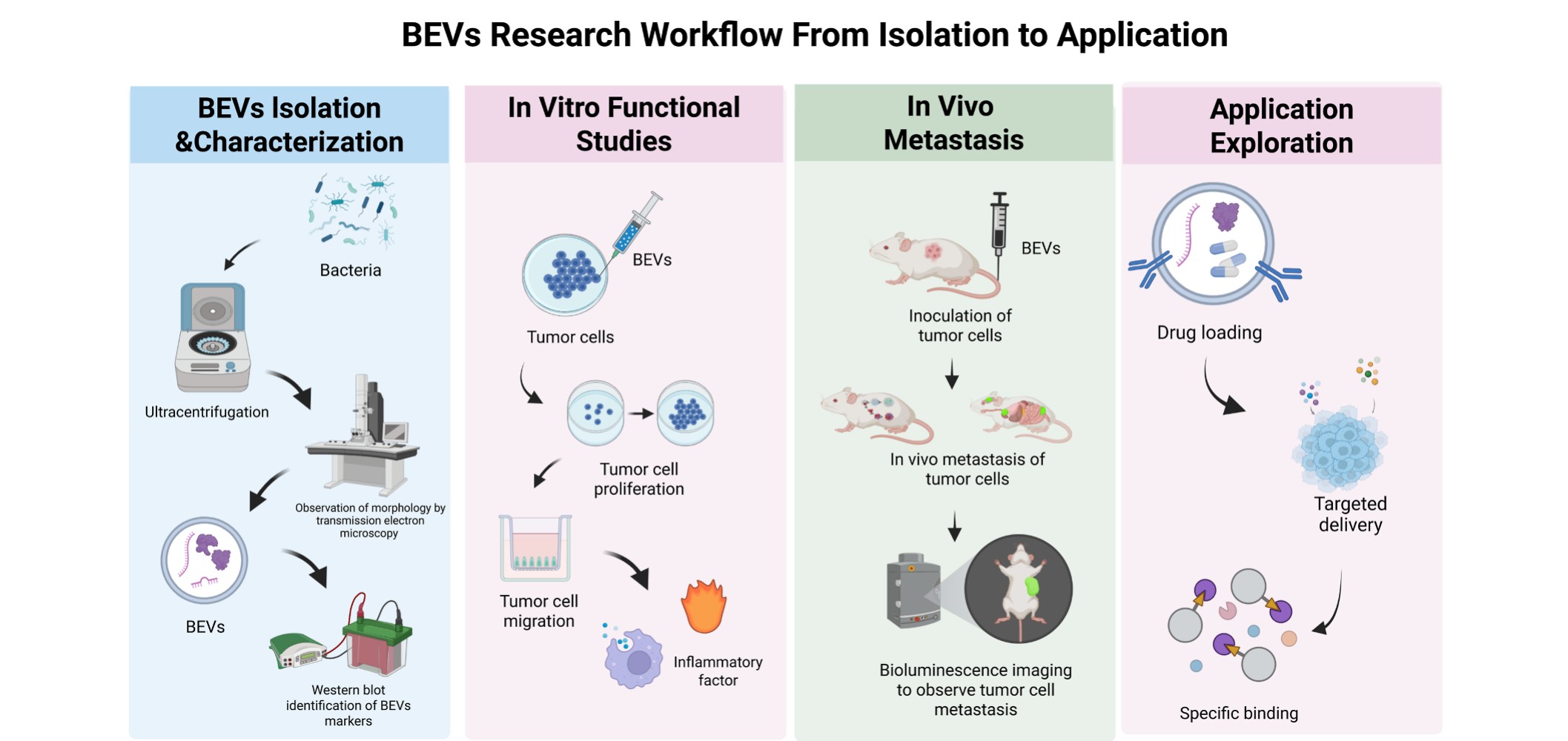
BEVs RESEARCH WORKFLOW FROM ISOLATION TO APPLICATION. CREDIT: XUE GAO ET AL.; CREATED WITH BIORENDER.COM.
GA, UNITED STATES, August 13, 2026 /EINPresswire.com/ -- Bacteria naturally release microscopic particles known as bacterial extracellular vesicles. This review considers how these vesicles could be adapted for precision cancer medicine, from carrying drugs and activating immune responses to limiting metastasis and identifying cancer biomarkers. It also examines the practical obstacles ahead, including inconsistent production, safety risks, contamination and the lack of shared manufacturing and quality standards.
Bacteria shed membrane-enclosed tiny particles filled with proteins, lipids, DNA, RNA and metabolites. These particles, commonly known as bacterial extracellular vesicles (BEVs), are now being explored as possible tools for cancer diagnosis and treatment.
A review published in Biomedical Technology surveys recent progress in BEVs, following the process from vesicle formation and purification through molecular analysis, engineering and early testing in cancer models.
“Part of their appeal lies in how they are made,” shares senior and co-corresponding author Duanrui Liu. “Scientists can grow bacteria in controlled conditions, alter the bacteria genetically and then modify the released vesicles chemically. This gives researchers several ways to adjust where the vesicles travel and what they carry.”
BEVs could, for example, be fitted with molecules that help them recognize tumors. “Drugs or therapeutic nucleic acids may be packed inside them,” says Liu. “Their bacterial origin also means they can alert the immune system, which may help trigger an anticancer response. The same molecular cargo could provide clues for liquid biopsy or the discovery of new cancer biomarkers.”
Notably, bacterial vesicles are unusual because they can act as both a delivery vehicle and an immune signa. “That combination creates exciting possibilities for precision oncology, but only if the field can make these vesicles consistently and prove that they are safe,” adds Liu.
The authors also compared BEVs with mammalian extracellular vesicles and conventional nanocarriers. New methods in synthetic biology, microfluidic isolation, multiomics analysis and surface modification are giving researchers finer control over vesicle design. Reproducibility, though, remains a persistent problem.
“A change in bacterial strain, culture conditions or purification method can alter the final product,” explains first author Xue Gao. “Yields may be low. Harmful bacterial material can remain after purification, and an immune response intended to fight cancer could instead produce damaging inflammation.”
Before BEVs move closer to the clinic, researchers will need more reliable manufacturing, strict testing of each batch and safer ways to reduce unwanted bacterial components. “Their place alongside chemotherapy, radiotherapy and immune checkpoint inhibitors must also be worked out,” adds Gao. “If those questions can be answered, these small vesicles may offer a single platform for drug delivery, cancer vaccines, immunotherapy and tumor monitoring.”
References
DOI
10.1016/j.bmt.2026.100138
Original Source URL
https://doi.org/10.1016/j.bmt.2026.100138
Funding information
This work was supported by National Natural Science Foundation of China (No. 82403361, 82071035, 82371165), Natural Science Foundation of Shandong Province (ZR2023QH463, ZR2022LZL001), Shandong Provincial Education Department Project (2024KJJ078), Young Talent of Lifting Engineering for Science and Technology in Shandong (SDAST2025QTA009), Foundation of National Center for Translational Medicine (Shanghai) SHU Branch (SUITM-202505), China International Medical Foundation Project (Z-2017-24-2509), Hong Kong Scholar Program (No. XJ2023056), Noncommunicable Chronic Diseases-National Science and Technology Major Project (2024ZD0533203), Collaborative Academic Innovation Project of Shandong Cancer Hospital (FC002), Hong Kong Research Grants Council (17103523 and SRFS2223-7S05) and the funding support from “Laboratory for Synthetic Chemistry and Chemical Biology” under the Health@InnoHK Program launched by Innovation and Technology Commission, HKSAR.
Lucy Wang
BioDesign Research
email us here
Legal Disclaimer:
EIN Presswire provides this news content "as is" without warranty of any kind. We do not accept any responsibility or liability for the accuracy, content, images, videos, licenses, completeness, legality, or reliability of the information contained in this article. If you have any complaints or copyright issues related to this article, kindly contact the author above.
