

Destination Management Service Market to Reach USD 16.7 Billion by 2035 as Personalized Travel Experiences Gain Momentum
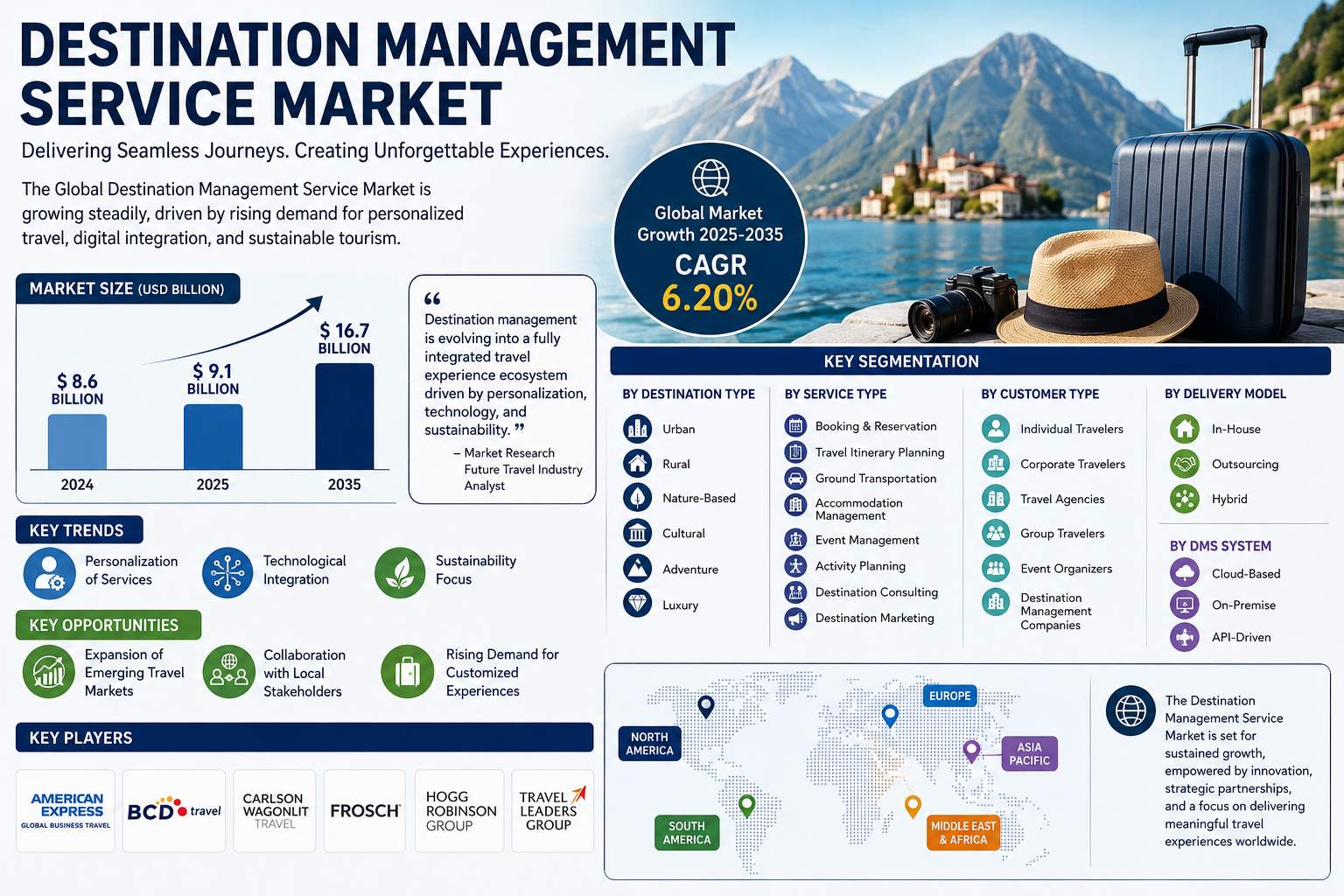
Destination Management Service Market
Rising demand for customized travel, digital transformation, and sustainable tourism practices are reshaping global destination management services
Destination management is evolving into a fully integrated travel experience ecosystem driven by personalization, technology, and sustainability.”
NEW YORK, NY, UNITED STATES, June 25, 2026 /EINPresswire.com/ -- The global Destination Management Service Market is witnessing steady expansion as travel ecosystems increasingly shift toward personalized, experience-driven, and technology-enabled solutions. According to the latest industry analysis, the market is valued at USD 8.6 billion in 2024, expected to reach USD 9.1 billion in 2025, and projected to climb to USD 16.7 billion by 2035, registering a compound annual growth rate (CAGR) of 6.20% during the forecast period (2025–2035).— Market Research Future (MRFR)
The growing complexity of global travel, rising corporate travel requirements, and increasing demand for curated local experiences are driving strong adoption of destination management services (DMS). These services play a crucial role in organizing travel logistics, managing itineraries, coordinating local experiences, and ensuring seamless execution of travel plans for both individual and corporate travelers.
As global tourism rebounds and evolves, destination management companies are becoming central to delivering structured, high-quality, and personalized travel experiences across regions.
Expanding Role of Destination Management in Modern Travel Ecosystems
Destination management services are evolving beyond traditional travel coordination to become comprehensive experience orchestration platforms. Modern travelers increasingly expect end-to-end solutions that combine transportation, accommodation, activities, cultural experiences, and real-time support.
This shift is particularly visible among corporate travelers and group travel organizers who require precision, reliability, and efficiency in managing large-scale travel operations. Destination management companies (DMCs) are responding by integrating digital platforms, automation tools, and data-driven planning systems to streamline operations.
The industry is also seeing increased collaboration between local tourism stakeholders, hospitality providers, and digital travel platforms, enabling more immersive and localized travel experiences.
Personalization Driving Market Transformation
One of the strongest forces reshaping the Destination Management Service Market is the growing demand for personalized travel experiences. Modern travelers are no longer satisfied with standardized tour packages and are instead seeking curated itineraries tailored to their interests, preferences, and travel purpose.
Destination management providers are leveraging customer data, behavioral insights, and AI-powered recommendation systems to design customized travel plans. This includes personalized cultural tours, adventure-based itineraries, luxury travel experiences, and niche tourism offerings such as wellness retreats and eco-tourism journeys.
Personalization is also becoming a key differentiator for corporate travel programs, where organizations require tailored solutions for employee travel, incentive trips, conferences, and business events.
Get Full PDF Sample Copy of Report: (Including Full TOC, List of Tables & Figures, Chart) @ https://www.marketresearchfuture.com/sample_request/29028
Technological Integration Enhancing Service Efficiency
Technology is playing a transformative role in the evolution of destination management services. Cloud-based platforms, API-driven integrations, and mobile-first travel applications are enabling real-time coordination and improved customer engagement.
Advanced booking systems now allow seamless integration of flights, hotels, ground transportation, and activity planning within a unified digital ecosystem. This reduces operational complexity while enhancing user convenience.
Artificial intelligence and machine learning are also being used to optimize travel planning, predict demand patterns, and recommend personalized travel experiences. Additionally, real-time tracking systems and digital communication tools are improving coordination between travelers, service providers, and destination managers.
These technological advancements are helping companies reduce costs, improve service delivery, and enhance customer satisfaction.
Sustainability Emerging as a Core Industry Priority
Sustainability has become a defining factor in the global travel and tourism industry, and destination management services are increasingly aligning with eco-friendly practices. Industry surveys indicate that more than 70% of travelers now consider sustainability when selecting travel providers, while nearly 60% are willing to pay a premium for low-impact travel options.
Travelers are becoming more conscious of their environmental footprint and are actively seeking sustainable tourism options such as eco-friendly accommodations, low-emission transportation, and responsible tourism activities. Demand is especially strong for rail-based travel, electric vehicle transfers, and hotels with recognized green certifications, with sustainable lodging bookings rising at a faster pace than conventional leisure stays in several major markets.
Destination management companies are responding by partnering with green-certified hotels, promoting carbon-offset travel programs, and designing itineraries that support local communities and preserve cultural heritage. Many providers are also incorporating waste-reduction measures, digital ticketing, and local sourcing strategies to reduce the environmental impact of group travel and event operations.
Sustainable tourism initiatives are also gaining traction among corporate clients, who are incorporating environmental, social, and governance (ESG) considerations into their travel policies. In fact, a growing share of multinational companies now require travel vendors to report emissions data, supplier sustainability credentials, and community impact metrics as part of procurement decisions.
This shift toward sustainability is expected to play a significant role in shaping long-term market growth and competitive positioning. As a result, destination management firms that can demonstrate measurable sustainability outcomes are likely to secure stronger contracts, higher client retention, and greater differentiation in an increasingly crowded market.
Market Segmentation Expands Service Diversity
The Destination Management Service Market is highly segmented, reflecting the diversity of global travel demands. Market demand is being shaped by differences in traveler purpose, destination maturity, service complexity, and digital adoption levels across regions.
By Destination Type
The market includes urban, rural, nature-based, cultural, adventure, and luxury destinations. Urban destinations continue to dominate due to business travel and international tourism hubs, while nature-based and adventure tourism segments are experiencing rapid growth driven by experiential travel trends. Urban destinations account for a substantial share of corporate and MICE-related bookings, whereas nature-based and cultural destinations are seeing stronger growth rates in leisure travel, particularly among younger travelers and high-income consumers seeking immersive experiences.
By Service Type
Core services include booking and reservation management, itinerary planning, ground transportation, accommodation management, event coordination, activity planning, destination consulting, and destination marketing. Among these, itinerary planning and event management remain critical for corporate and group travel. Booking and reservation management continues to represent one of the largest service categories, while destination consulting and marketing are expanding as tourism boards and hospitality partners seek more targeted visitor engagement strategies.
By Customer Type
Key customer groups include individual travelers, corporate travelers, travel agencies, group travelers, event organizers, and destination management companies. Corporate travelers and event organizers represent a significant share due to the complexity of business travel logistics. Group travel and incentive travel are also gaining momentum, with demand rising for customized packages that can accommodate 20 to 200 participants or more, depending on the event scale.
By Delivery Model
The industry operates through in-house service delivery, outsourcing models, and hybrid systems. Hybrid models are gaining popularity as they combine internal expertise with external service flexibility. This model is particularly attractive for companies managing multi-country itineraries, seasonal demand spikes, and specialized local experiences that require on-the-ground coordination.
By Destination Management System
Technology infrastructure includes cloud-based systems, on-premise solutions, and API-driven platforms. Cloud-based systems are increasingly preferred due to scalability, cost efficiency, and real-time accessibility. API-driven platforms are also gaining traction as they enable seamless integration with airline, hotel, payment, and customer relationship management systems, improving operational efficiency and traveler visibility across the service chain.
Rising Corporate Travel Strengthens Market Demand
Corporate travel remains one of the most influential drivers of the Destination Management Service Market. Businesses increasingly rely on destination management companies to handle complex travel arrangements for conferences, meetings, incentive trips, and international assignments. In many organizations, business travel and events account for a meaningful share of annual travel budgets, making efficient coordination and cost control essential.
Companies such as American Express Global Business Travel, BCD Travel, and Carlson Wagonlit Travel are expanding their service offerings to include integrated travel solutions that combine logistics, event planning, and traveler support. These providers are increasingly using centralized dashboards, automated booking tools, and real-time traveler tracking to improve service quality and reduce administrative burden.
The need for cost optimization, travel policy compliance, and employee experience enhancement is further driving corporate adoption of destination management services. Organizations are also placing greater emphasis on duty-of-care capabilities, with many requiring 24/7 support, emergency response coordination, and risk monitoring for employees traveling across multiple regions.
Leisure and Experience-Based Tourism Expands Rapidly
Leisure tourism continues to evolve toward experience-driven travel, where consumers prioritize unique cultural, adventure, and lifestyle experiences over traditional sightseeing. This shift is supported by rising disposable incomes, social media influence, and the growing popularity of personalized travel planning.
Destination management providers are capitalizing on this shift by offering curated experiences such as guided cultural tours, adventure expeditions, culinary travel programs, and luxury wellness retreats. Demand is particularly strong for multi-day itineraries that combine local attractions, authentic dining, and exclusive access to regional experiences.
This trend is particularly strong among millennials and Gen Z travelers, who value authenticity, personalization, and immersive experiences. These traveler groups are also more likely to book through digital channels, compare multiple service options, and seek flexible itineraries that can be adjusted in real time.
Regional Insights Highlight Global Growth Opportunities
North America remains a leading market due to strong corporate travel demand, advanced tourism infrastructure, and high adoption of digital travel solutions. The United States continues to drive regional growth with a mature travel ecosystem and strong presence of global travel management companies. The region also benefits from a large base of business events, conventions, and incentive travel programs that support steady demand for destination management services.
Europe represents a significant market supported by cultural tourism, cross-border travel, and well-developed transportation networks. Countries such as the United Kingdom, France, Germany, and Italy continue to attract high volumes of international tourists. Europe’s strong emphasis on heritage tourism, sustainable travel, and regional mobility is also contributing to the expansion of destination management offerings.
Asia Pacific is expected to witness the fastest growth over the forecast period. Rising disposable incomes, expanding middle-class populations, and increasing international travel from countries such as China, India, Japan, and Southeast Asia are driving strong demand for destination management services. The region is also seeing rapid growth in domestic tourism, outbound leisure travel, and corporate event activity, creating substantial opportunities for service providers.
South America and the Middle East & Africa are emerging markets with growing tourism investments, infrastructure development, and increasing international visitor inflows. These regions are expected to gain momentum as global travel networks expand. In particular, destination-led tourism development, major sporting events, and government-backed tourism initiatives are helping to improve visibility and attract new traveler segments.
Competitive Landscape and Key Players
The Destination Management Service Market is highly competitive, with global and regional players focusing on innovation, partnerships, and service diversification.
Key companies include:
• American Express Global Business Travel
• BCD Travel
• Carlson Wagonlit Travel
• Frosch
• Hogg Robinson Group
• Travel Leaders Group
These companies are investing in digital transformation, AI-based travel planning tools, sustainability initiatives, and strategic alliances with local service providers to enhance their global presence.
Customer experience, operational efficiency, and real-time service coordination remain key competitive factors in the industry.
Emerging Opportunities and Market Trends
Several emerging trends are shaping the future of destination management services:
• Increasing integration of artificial intelligence for travel personalization, as destination management companies use AI tools to analyze traveler preferences, recommend tailored itineraries, and improve booking efficiency
• Expansion of experiential and niche tourism segments, driven by growing demand for unique travel experiences such as adventure trips, cultural tours, wellness retreats, and culinary tourism
• Growth of sustainable and eco-conscious travel programs, as more travelers and corporate clients seek environmentally responsible options including green accommodations, low-emission transport, and community-based tourism
• Rising collaboration with local tourism stakeholders, which helps destination managers create more authentic experiences by working with hotels, transport providers, guides, and cultural organizations
• Increasing adoption of mobile-first travel management platforms, enabling travelers and service providers to access real-time updates, manage bookings, and coordinate itineraries more conveniently through smartphones
These trends are expected to create significant opportunities for service providers and technology developers across the global travel ecosystem.
Future Outlook
The Destination Management Service Market is poised for steady and sustained growth as global travel continues to evolve toward personalization, digital integration, and sustainability. With increasing demand for curated travel experiences and seamless logistics management, destination management companies are expected to play a more strategic role in shaping global tourism experiences.
By 2035, the market is projected to reach USD 16.7 billion, supported by strong growth across corporate travel, leisure tourism, and experience-based travel segments. As technology continues to transform the travel industry, destination management services will remain central to delivering efficient, customized, and high-quality travel experiences worldwide.
Discover Related Research Reports By Market Research Future:
Events Industry Market
https://www.marketresearchfuture.com/reports/events-industry-market-12035
Halal Tourism Industry Overview Market
https://www.marketresearchfuture.com/reports/halal-tourism-industry-overview-market-26388
MICE Tourism Market
https://www.marketresearchfuture.com/reports/mice-tourism-market-26429
Sagar Kadam
Market Research Future
+1 628-258-0071
email us here
Visit us on social media:
LinkedIn
Facebook
YouTube
X
Legal Disclaimer:
EIN Presswire provides this news content "as is" without warranty of any kind. We do not accept any responsibility or liability for the accuracy, content, images, videos, licenses, completeness, legality, or reliability of the information contained in this article. If you have any complaints or copyright issues related to this article, kindly contact the author above.
