

With 10.1% CAGR, Rapid Microbiology Testing Market to reach USD 16.91 Billion by 2035
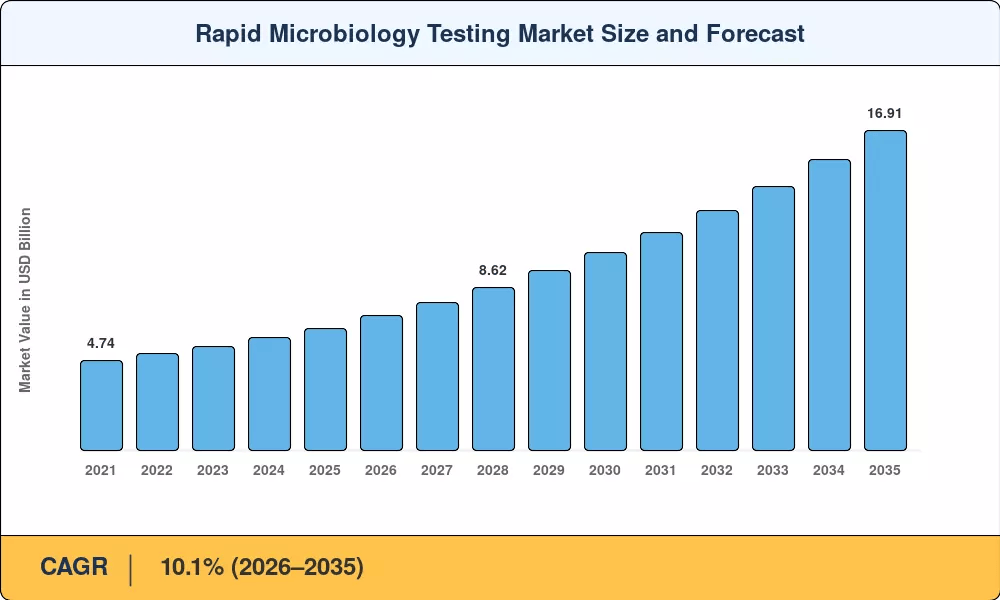
Rapid Microbiology Testing Market Size
Rapid Microbiology Testing Market to Surge from USD 7.11B in 2026 to USD 16.91B by 2035- By FDA Mass-Spectrometry Reclassification, Pharma Lab Automation
NY, CA, UNITED STATES, June 24, 2026 /EINPresswire.com/ -- As per Market Research Future, the global Rapid Microbiology Testing Market size is projected to reach USD 16.91 Billion by 2035 from USD 7.11 Billion in 2026, at a CAGR of 10.1% during the forecast period 2026–2035. The market base was estimated at USD 6.46 Billion in 2025.The 10.1% CAGR—anchored by structural diagnostic and quality-control demand rather than discretionary healthcare spending—is driven by three converging forces: the FDA's 2025 reclassification of clinical mass-spectrometry systems to Class II device status, which reduced compliance costs for diagnostic labs, sustained pharmaceutical company investment exceeding USD 3.2 billion collectively in total laboratory automation between 2023 and 2025, and the technological shift from legacy culture-based methods that necessitate 7–14 days for sterility confirmation toward automated platforms and molecular detection systems that compress detection windows from days to hours.
National governments and multilateral health organizations are amplifying this momentum. The WHO's revised Annex 1 guidelines for sterile manufacturing impose faster release-cycle mandates across all aseptic manufacturing facilities, while the FDA's Food Safety Modernization Act enforces rigorous preventive controls across food supply chains.
Request A Free Sample:
https://www.marketresearchfuture.com/sample_request/24716
Key Market Trends & Growth Drivers
FDA Mass-Spectrometry Reclassification and Regulatory Push for Faster Drug Release Testing
The FDA's 2025 reclassification of clinical mass-spectrometry systems to Class II device status under 21 CFR 866.2300 mandates a 510(k) premarket notification pathway rather than a full premarket approval (PMA), lowering administrative barriers for diagnostic manufacturers while strictly enforcing analytical performance standards. This regulatory shift is estimated to accelerate MALDI-TOF platform adoption by 25–30% across U.S. clinical laboratories.
MALDI-TOF mass spectrometry achieves bacterial identification accuracy exceeding 94% in under ten minutes, compressing traditional 48–72 hour biochemical identification workflows into a single automated step. Each percentage point of mass-spectrometry platform adoption translates into measurable consumable and service revenue, and the regulatory reclassification embedded in routine laboratory economics makes this driver structurally durable through 2035.
Complementing the FDA framework, the WHO's revised Annex 1 guidelines for sterile manufacturing impose faster release-cycle mandates across all aseptic manufacturing facilities. The European Medicines Agency's Annex 1 enforcement timeline requires full compliance by 2025, converting voluntary rapid-method adoption into mandatory compliance.
Pharmaceutical Lab Automation and Platform Consolidation
Pharmaceutical companies invested over USD 3.2 billion collectively in total laboratory automation between 2023 and 2025. Total laboratory automation acts as a primary vector for quality improvement in modern health infrastructure; an estimated 60% to 80% of health laboratory work is highly feasible for automation.
Transitioning manual processing into automated streams reduces common analytical errors from approximately 8% down to 1%, significantly improving specimen throughput, reporting accuracy, and clinical workflow safety without requiring proportional expansions in manual labor.
Automated blood-culture systems have compressed detection windows from days to hours, and modern platforms pair rapid identification with reflex antimicrobial susceptibility testing (AST), routing positive cultures directly to automated susceptibility panels. This integration cuts time-to-targeted-therapy from 48–72 hours to under 18 hours.
Point-of-Care and Decentralized Diagnostics Expansion
Global public health frameworks heavily drive the demand for rapid near-patient diagnostics. The WHO highlights antimicrobial resistance as a top-tier threat directly responsible for over 1.2 million global deaths annually. The UN target established at the General Assembly aims for a 10% reduction in resistance-associated mortality by 2030.
Achieving this target depends heavily on expanding access to rapid, decentralized diagnostics to prevent inappropriate antimicrobial use. Lateral-flow immunoassays offer low-cost, point-of-care deployment without laboratory infrastructure—a critical advantage for food-plant line testing and decentralized clinical trials.
In January 2026, bioMérieux acquired Accellix to integrate automated, rapid flow cytometry platforms into its pharmaceutical quality control portfolio for advanced cell and gene therapy validation.
Ask for Customization:
https://www.marketresearchfuture.com/ask_for_customize/24716
Market Segment Insights
BY PRODUCT TYPE
Consumables: Dominant segment with ~49.1% revenue share in 2025. Driven by recurring demand for culture media, reagent cassettes, and sample-preparation kits. bioMérieux's BACT/ALERT and BD's BACTEC systems both operate on closed consumable ecosystems that lock in multi-year purchasing agreements.
Instruments: Fastest-growing product category at 11.6% CAGR (2026–2035). Reflecting capital investment in automated platforms and mass-spectrometry analyzers as labs replace aging analyzers and greenfield facilities in Asia-Pacific install first-generation rapid-testing platforms.
BY METHOD
Nucleic Acid-Based: Dominant method with ~57.8% revenue share in 2025. Underpinned by PCR, qPCR, and next-generation sequencing adoption across clinical and pharmaceutical labs. Reflects the clinical laboratory sector's heavy reliance on PCR for respiratory-pathogen panels, blood-culture identification, and sexually transmitted infection screening.
Immunological: Fastest-growing method at 11.4% CAGR (2026–2035). Supported by lateral-flow assay deployment in decentralized testing sites. Low-cost, point-of-care deployment without laboratory infrastructure creates a critical advantage for food-plant line testing and decentralized clinical trials.
BY APPLICATION
Clinical Diagnostics: Dominant application with ~49.2% revenue share in 2025. Led by blood-culture and respiratory-pathogen testing volumes. Hospital blood-culture volumes alone exceeded 60 million tests annually in the United States in 2024.
Pharmaceutical & Biotech QC: Fastest-growing application at 12.9% CAGR (2026–2035). Sterile-manufacturing oversight intensifies under Annex 1 enforcement, and cell-therapy manufacturing expansion drives mandatory transitions toward rapid microbiological methods. Autologous cellular products possess brief physiological shelf lives, rendering traditional 14-day compendial incubation periods logistically non-viable.
BY END USER
Clinical Laboratories: Largest segment at ~52.5% share in 2025. Serve as the aggregation point for diagnostic testing volume across hospital networks and commercial reference labs.
Pharmaceutical & Biotech Companies: Fastest-growing end-user segment at 12.8% CAGR (2026–2035). Investing heavily in captive microbiology labs to bring sterility testing in-house rather than outsourcing to contract testing organizations, accelerating instrument procurement and consumable consumption.
Read Detailed Insights:
https://www.marketresearchfuture.com/reports/rapid-microbiology-testing-market-24716
Regional Outlook
North America — Dominant Market (~42.0% Share, 2025)
The United States generates approximately 78.4% of North American Rapid Microbiology Testing Market revenue, driven by rigorous FDA and USP <71> enforcement throughout the pharmaceutical supply chain, the world's largest pharmaceutical manufacturing base, and over 300 million clinical microbiology tests performed annually in 2024.
Medicare reimbursement for molecular diagnostics grew 8% year-over-year. The FDA's 2025 mass-spectrometry reclassification to Class II status converted a PMA-dominated market into one with a structural 510(k) pathway tail, accelerating MALDI-TOF adoption across clinical and industrial laboratories.
Europe — Second Largest (~28.5% Share, 2025)
Europe's Rapid Microbiology Testing Market is shaped by the EU's Annex 1 enforcement timeline, which requires full compliance across all aseptic manufacturing facilities by 2025. Germany leads with 8.5% CAGR, driven by pharmaceutical manufacturing density—home to three of the world's top 20 drug manufacturers—and DIN standards leadership. The UK contributes USD 0.31 Billion on MHRA post-Brexit regulatory autonomy and its own validation pathway for rapid methods.
France contributes 15.8% of regional share on biopharma clusters and AFNOR validation leadership. Italy holds 10.2% of regional share on generic pharma QC demand. Spain is growing at 7.6% CAGR on food-export microbiology testing growth. The Nordic countries contribute 8.1% of regional share on AMR surveillance programs.
Asia-Pacific — Fastest-Growing Region (10.8% CAGR, 2026–2035)
Asia-Pacific is the engine of the Rapid Microbiology Testing Market. China holds the largest regional share at 34.2%, with the 14th Five-Year Plan for medical-equipment localization directing state-backed capital toward domestic manufacturers, while the biopharma sector attracted USD 18.5 billion in venture funding between 2022 and 2024. New CDMO facilities in Suzhou, Shanghai, and Chengdu are equipped with automated sterility testing from day one.
Middle East & Africa — Emerging Opportunity (4.5% Share, 2025)
The Middle East & Africa carries the widest diagnostic infrastructure gap and therefore significant opportunity. Saudi Arabia leads the region with 28.4% share, with Vision 2030 healthcare transformation allocating over USD 65 billion for hospital construction and laboratory modernization through 2030, creating a concentrated procurement wave for the Rapid Microbiology Testing Market. The UAE holds 22.1% of regional share on medical tourism hub strategy and HAAD standards alignment.
South America — Growing Presence (USD 0.32 Billion, 2025)
Brazil anchors South America's Rapid Microbiology Testing Market at ~62.5% of regional revenue, with ANVISA increasingly mirroring FDA and EMA validation frameworks for rapid microbiological methods, encouraging multinational instrument vendors to register products simultaneously across North and South American markets.
The country's 2024 National Diagnostic Plan earmarked BRL 2.8 billion for laboratory equipment procurement, with rapid microbiology platforms listed as a priority category. Argentina holds 19.8% of regional share on agricultural-export food safety.
Competitive Landscape and Recent Developments
The Rapid Microbiology Testing Market exhibits medium concentration, with an estimated Herfindahl-Hirschman Index in the 900–1,200 range and the top five players collectively holding an estimated 52–58% of global revenue. Concentration is highest in high-income segments where regulatory and manufacturing barriers are steep; the pooled-procurement tier is more fragmented as regional producers compete on price. Strategic activity centers on platform expansion, AI integration, and geographic distribution partnerships.
The competitive landscape is stratified between full-spectrum identification and AST automation leaders serving clinical and pharmaceutical markets, molecular point-of-care specialists capturing decentralized testing growth, and niche players dominating food-safety and environmental monitoring segments.
KEY COMPANIES AND RECENT MILESTONES
bioMérieux (January 2026): Acquired Accellix to integrate automated, rapid flow cytometry platforms into its pharmaceutical quality control portfolio for advanced cell and gene therapy validation. BACT/ALERT, VITEK, and BioFire FilmArray anchor a full-spectrum ID and AST automation leadership position. Estimated revenue share: ~12–16%.
Becton Dickinson (BD) (2024–2025): BACTEC, Kiestra TLA, and BD MAX anchor a total lab automation pioneer position. The company benefits from the structural automation tail created by pharmaceutical QC investment cycles. Estimated revenue share: ~10–14%.
Thermo Fisher Scientific (2024–2025): Applied Biosystems PCR and Oxoid media anchor molecular and culture-media breadth. Estimated revenue share: ~8–12%.
Charles River Laboratories (2024–2025): Celsis, Endosafe, and Accugenix anchor a pharma QC and endotoxin testing specialist position. Estimated revenue share: ~6–9%.
Merck KGaA (2024–2025): Milliflex, MAS-100, and Steritest anchor a sterility and bioburden testing focus. Estimated revenue share: ~5–8%.
Future Outlook: 2026–2035
By 2030, AI-powered microbial identification and predictive analytics will become the operating system of rapid microbiology testing delivery. Machine learning models significantly optimize mass spectrometry interpretation by refining spectral data processing; integrating convolutional neural networks into diagnostic workflows reduces the standard algorithmic identification timeline for critical isolates down to real-time parameters.
Implementing cloud-native predictive analytics directly into instrument software allows laboratories to evaluate complex phenotypic data patterns instantaneously, enhancing diagnostic precision and helping clinical facilities bypass traditional multi-step confirmation protocols. Vendors packaging anonymized data analytics as a subscription service alongside hardware sales unlock recurring revenue streams while strengthening customer retention within the Rapid Microbiology Testing Market.
Next-generation sequencing as a routine diagnostic tool will reframe cost structures by the early 2030s. Whole-genome sequencing costs fell below USD 200 per sample in 2024 and are projected to reach USD 50 by 2030. At that price point, metagenomic sequencing becomes economically viable for routine infection diagnostics—not just outbreak investigation.
The Rapid Microbiology Testing Market will absorb a sequencing-native segment that blurs the line between traditional culture-based microbiology and genomics, creating new revenue pools for library-preparation consumables, bioinformatics software, and sample-prep automation.
More Related Research Insights:
https://www.marketresearchfuture.com/reports/microbiology-testing-market-697
https://www.marketresearchfuture.com/reports/infectious-disease-diagnosis-treatment-market-7031
https://www.marketresearchfuture.com/reports/molecular-diagnostics-market-1171
https://www.marketresearchfuture.com/reports/in-vitro-diagnostics-market-1165
https://www.marketresearchfuture.com/press-release/pcr-technology-market
https://www.marketresearchfuture.com/reports/clinical-laboratory-services-market-7145
https://www.marketresearchfuture.com/reports/point-of-care-diagnostics-testing-market-10642
https://www.marketresearchfuture.com/reports/antibiotic-susceptibility-testing-market-26881
https://www.marketresearchfuture.com/reports/immunoassay-market-5841
https://www.marketresearchfuture.com/reports/hospital-acquired-infections-market-2576
Larry Wilson
WantStats Research And Media Pvt. Ltd.
+1 855-661-4441
email us here
Visit us on social media:
LinkedIn
Facebook
YouTube
X
Legal Disclaimer:
EIN Presswire provides this news content "as is" without warranty of any kind. We do not accept any responsibility or liability for the accuracy, content, images, videos, licenses, completeness, legality, or reliability of the information contained in this article. If you have any complaints or copyright issues related to this article, kindly contact the author above.
