
Green Cement Market Projected to Expand from USD 34.50 Billion in 2025 to USD 71.72 Billion by 2035 | CAGR 7.6%
Green Cement Market
Asia-Pacific registered the fastest CAGR at 8.6%, with China and India together accounting for over 60% of regional demand growth.
WA, UNITED STATES, June 19, 2026 /EINPresswire.com/ -- The global green cement market is emerging as a critical segment within the construction and building materials industry, driven by increasing environmental concerns, carbon reduction mandates, and the global shift toward sustainable infrastructure. Green cement is produced using alternative raw materials such as fly ash, slag, and industrial waste, significantly reducing CO₂ emissions compared to conventional cement.Market Overview, Size and CAGR
The green cement market is undergoing significant transformation as governments, construction companies, and infrastructure developers increasingly prioritize sustainability. Unlike conventional cement, green cement reduces greenhouse gas emissions by utilizing industrial by-products such as fly ash and slag, or through low-carbon production technologies.
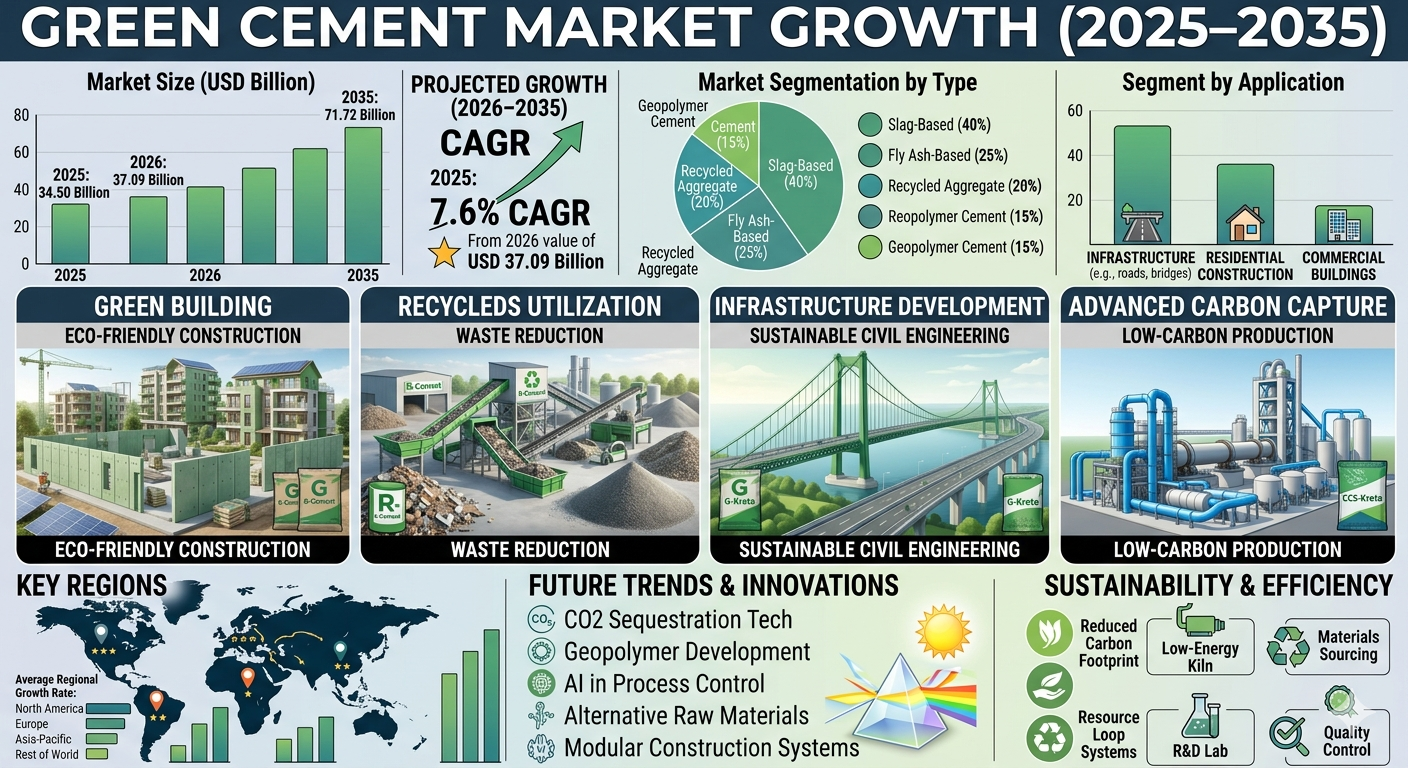
The according to Market Research Future analysis, Green Cement Market reached an estimated USD 34.50 Billion in 2025, is projected to touch USD 37.09 Billion in 2026, and is on course to climb to USD 71.72 Billion by 2035 at a 7.6% CAGR across the 2026–2035 forecast window.
One of the key drivers of this expansion is the global push toward net-zero carbon emissions. Cement production is traditionally one of the largest industrial contributors to CO₂ emissions, accounting for a significant share of global carbon output. As a result, governments are implementing strict environmental regulations and carbon reduction targets, encouraging the adoption of low-carbon alternatives.
Additionally, increasing investment in urbanization and infrastructure development, especially in emerging economies, is boosting demand for sustainable cement solutions. Rapid growth in residential construction, road networks, and commercial infrastructure is further accelerating adoption.
Technological advancements, including carbon capture utilization (CCU), geopolymer cement technology, and alternative raw material processing, are also enhancing product performance and scalability.
Overall, the market is transitioning from a niche eco-friendly segment to a mainstream construction material category with strong long-term growth potential.
Get Report Sample Copy with TOC: https://www.marketresearchfuture.com/sample_request/2907
Key Market Segments in Detail
The green cement market is segmented based on type and application, each playing a vital role in shaping market demand and adoption trends.
By Type
The market includes:
Fly ash-based cement
Slag-based cement
Geopolymer cement
Others (including silica fume and recycled material-based cement)
Fly ash-based cement dominates the market due to the wide availability of fly ash from coal-fired power plants and its cost-effectiveness. It is widely used in residential and infrastructure construction due to its durability and reduced carbon footprint.
Slag-based cement is also gaining strong traction, especially in heavy infrastructure projects, as it offers improved strength, chemical resistance, and long-term durability. It is increasingly used in marine and industrial construction environments.
Geopolymer cement represents the most innovative segment. It uses industrial waste and chemical activation processes to eliminate or significantly reduce Portland cement content, making it one of the most sustainable alternatives. However, higher production costs currently limit large-scale adoption.
By Application
The green cement market is segmented into:
Residential construction
Non-residential construction (commercial and industrial)
The non-residential segment dominates the market, driven by large-scale infrastructure projects, commercial buildings, highways, bridges, and industrial facilities. Governments across developed and emerging economies are investing heavily in sustainable infrastructure development, which strongly supports this segment.
The residential segment is also growing steadily due to increasing awareness of eco-friendly housing and rising demand for sustainable building materials in urban housing projects. Green building certifications such as LEED and BREEAM are further encouraging adoption in residential construction.
Regional Insights
The global green cement market shows strong regional diversification:
Asia-Pacific
Asia-Pacific is the fastest-growing region, driven by rapid urbanization, infrastructure expansion, and large-scale construction activity in countries such as China, India, and Southeast Asia. The region benefits from abundant availability of industrial by-products like fly ash and slag, supporting cost-effective production.
North America
North America holds a leading position in the market, supported by strong sustainability policies, green building regulations, and government incentives for low-carbon construction materials. The United States is a major adopter due to increasing focus on decarbonizing the construction sector.
Europe
Europe is a highly mature and regulated market, where strict environmental laws and carbon taxation are accelerating the adoption of green cement. Countries such as Germany, France, and the UK are investing heavily in sustainable infrastructure and circular economy initiatives.
Rest of the World
Latin America, the Middle East, and Africa are emerging markets, where infrastructure development and growing environmental awareness are gradually increasing adoption of green cement technologies.
Buy Now: https://www.marketresearchfuture.com/checkout?currency=one_user-USD&report_id=2907
Market Drivers and Challenges
Drivers
Increasing global carbon reduction targets
Rising demand for sustainable construction materials
Growth in infrastructure and urban development
Availability of industrial by-products (fly ash, slag)
Government incentives and green building standards
Challenges
Higher initial production costs compared to traditional cement
Limited awareness in developing regions
Infrastructure limitations for large-scale production
Technical performance variations across formulations
Future Opportunities
The green cement market presents significant future opportunities driven by the global transition toward sustainable construction. Advancements in carbon capture and storage (CCS) technologies and low-carbon cement production methods will further enhance market potential.
Emerging opportunities include expansion into net-zero buildings, smart cities, and sustainable infrastructure projects. Additionally, innovations in geopolymer chemistry and waste utilization will improve cost efficiency and scalability, making green cement a mainstream construction material by 2035.
Related Report
Low Foam Surfactants Market https://www.marketresearchfuture.com/reports/low-foam-surfactants-market-8143
Hydrogen Peroxide Market https://www.marketresearchfuture.com/reports/hydrogen-peroxide-market-7396
Stainless Steel Market https://www.marketresearchfuture.com/reports/stainless-steel-market-16145
Ultra-Fine Copper Powder Market https://www.marketresearchfuture.com/reports/ultra-fine-copper-powder-market-11787
Market Research Future
Market Research Future
+1 855-661-4441
email us here
Visit us on social media:
LinkedIn
Facebook
X
Legal Disclaimer:
EIN Presswire provides this news content "as is" without warranty of any kind. We do not accept any responsibility or liability for the accuracy, content, images, videos, licenses, completeness, legality, or reliability of the information contained in this article. If you have any complaints or copyright issues related to this article, kindly contact the author above.
