

Robotic Grippers Market CAGR to Stand at 6.3% During 2026–2033 | Persistence Market Research
robotic grippers market
The robotic grippers market is rapidly growing, driven by automation in automotive, semiconductor, food, and medical industries worldwide.
LONDON, UNITED KINGDOM, April 29, 2026 /EINPresswire.com/ -- The global robotic grippers market is poised for significant growth, with an estimated valuation of US$ 2.1 billion in 2026, projected to reach US$ 3.3 billion by 2033, reflecting a CAGR of 6.3% between 2026 and 2033. This growth is driven by the widespread adoption of industrial automation in automotive assembly, semiconductor fabrication, and food packaging operations worldwide. Key catalysts include the U.S. CHIPS Act, which has catalyzed over US$ 500 billion in semiconductor capacity expansion, and the EU semiconductor market’s 12.3% growth in 2022. Additionally, structural transformations in B2B e-commerce, with a CAGR of 14.5% from 2017 to 2026 and a gross merchandise value increase from US$ 9,837 billion to US$ 36,163 billion, have heightened logistics automation needs, supporting precise gripper deployment. These macro trends position robotic grippers as indispensable components in precision manufacturing ecosystems.
Download Your Free Sample & Explore Key Insights: https://www.persistencemarketresearch.com/samples/36127
Market Dynamics
Drivers: Semiconductor Manufacturing Capacity Expansion
Robotic grippers are essential in semiconductor fabrication, requiring precise handling of silicon wafers, microchips, and delicate components to prevent contamination and yield loss. The U.S. CHIPS Act has spurred private investments across 28 states, aiming to double fabrication capacity by 2032 and increase domestic output from 10% to 14% of global capacity. New fabs integrating end-to-end automation drive demand for vacuum and soft grippers certified for semiconductor protocols. Cleanroom-compatible mechanical grippers for FOUP transfer protocols are becoming standard in capital-intensive greenfield projects.
Automotive Electrification and Lightweight Materials
The rise of electric vehicles has prompted OEMs to deploy robotic grippers capable of handling lightweight composite materials, battery modules, and electronic components. BMW’s 2024 deployment of 3D-printed bionic grippers achieved a 30% weight reduction while handling CFRP assemblies. Global EVs contain triple the semiconductor content of internal combustion vehicles, necessitating grippers for thermal management modules and power electronics. Regulatory mandates for CO2 reduction and ISO 10218 collaborative robot standards further accelerate adoption.
Food Processing and High-Speed Packaging
Stringent hygiene protocols and high-speed packaging lines require IP69K-rated, corrosion-resistant grippers. Festo’s HPSX Universal Adaptive Gripper uses food-grade silicone for multiple picks per second, meeting EHEDG certification requirements. OnRobot’s VGP20 electric vacuum gripper reduces operating costs by 90% versus pneumatic alternatives, supporting irregular produce and primary packaging operations globally.
Get Custom Insights Designed for Your Businecss: https://www.persistencemarketresearch.com/request-customization/36127
Restraints: Certification Costs and Supply Chain Dependencies
Cleanroom certification for semiconductor grippers can cost $250K–$500K per family, with validation cycles of 6–12 months. Automotive PPAP Level 3 approval spans 9–18 months, consuming numerous prototypes. Food and pharmaceutical compliance increases costs 3–5 times over industrial grippers. Additionally, reliance on rare-earth materials and precision components, including neodymium magnets and FKM seals, introduces price volatility and production delays, constraining scalability.
Opportunities: Collaborative Robot Integration and Soft Robotics
Collaborative robots (cobots) drive demand for standardized, plug-and-play gripper interfaces. OnRobot’s 2FG14/3FG25 and SMC’s LEHR series enable rapid deployment across multiple platforms. Soft grippers address delicate object handling in agriculture and medical applications, supported by USDA and NIH grants. These actuators achieve gentle grasp forces, energy efficiency, and compliance with ISO 13485, expanding their use across food safety and healthcare.
Regional Insights
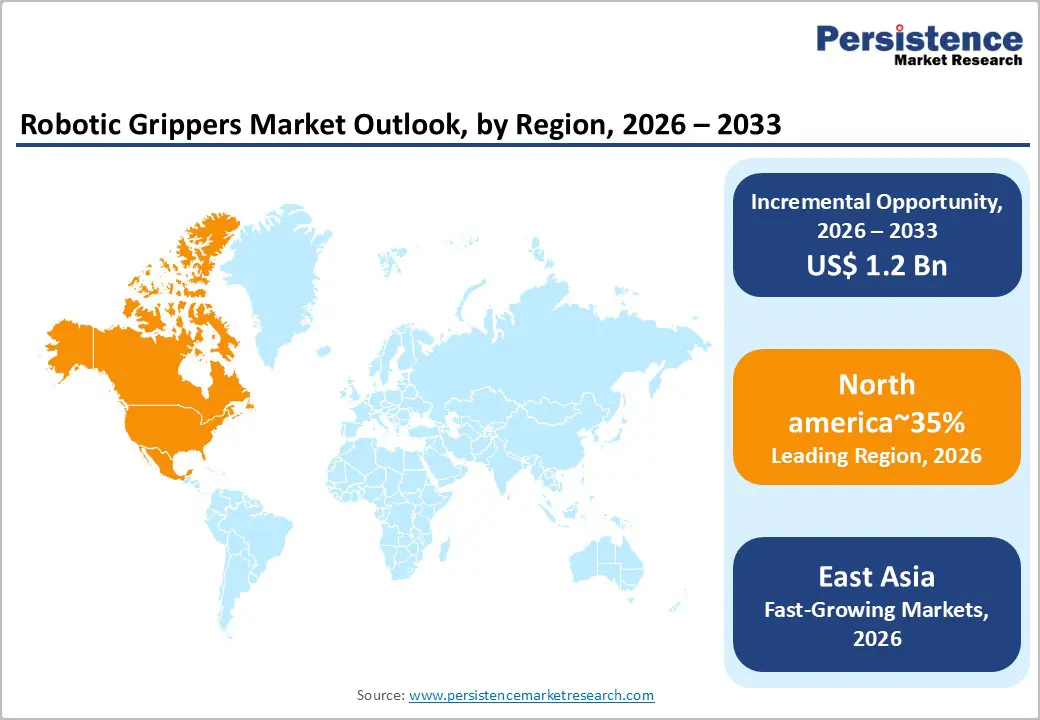
North America dominates with a 35% market share, fueled by CHIPS Act investments and EV platform assembly. East Asia holds 20%, driven by semiconductor leadership, automotive robotics, and energy-efficient SMA grippers. Europe accounts for 25%, with growth supported by automotive premiumization, food processing automation, and regulatory compliance.
Product and End-User Insights
Mechanical grippers lead with a 34.2% market share, favored for robustness in heavy payload operations. Soft and vacuum grippers are the fastest-growing segments, ideal for delicate handling in food, semiconductor, and medical sectors. Automotive is the leading end-user at 22%, driven by EV assembly, multi-finger tooling, and lightweight composite handling.
Get Custom Insights Designed for Your Businecss: https://www.persistencemarketresearch.com/request-customization/36127
Robotic Grippers Market Segmentation
By Gripper Type
Mechanical Grippers
Vacuum Grippers
Magnetic Grippers
Soft or Compliant Grippers
Hydraulic Grippers
Misc.
By Application
Pick and Place
Assembly and Installation
Material Handling and Transfer
Machine Tending
Packaging and Palletizing
Inspection and Sorting
Misc.
By Industry
Automotive and Transportation
Electronics and Semiconductor
Food and Beverage and Packaging
Logistic
Medical Devices
Metal and Fabrication
Consumer Goods
Agriculture
Misc.
By Region
North America
Europe
East Asia
South Asia Oceania
Latin America
Middle East & Africa
Competitive Landscape
The market is fragmented, with key players including SCHUNK, Festo, OnRobot, DESTACO, Robotiq, Universal Robotics, Applied Robotics, and others. Technological advancements such as tactile sensing, AI integration, and digital twins are reshaping the landscape. Recent developments include Universal Robots, Robotiq, and Siemens’ smart palletising system at CES 2026 and Robotiq’s TSF-85 tactile sensor fingertips, enabling robots to interact more effectively with complex objects and environments.
The robotic grippers market is set to remain dynamic, driven by technological innovation, regional semiconductor expansion, automotive electrification, and food and medical industry automation needs, positioning it as a cornerstone of next-generation industrial automation.
Read Related Reports:
Farm Equipment Rental Market: The farm equipment rental market is set to grow from US$ 48.4 Bn in 2026 to US$ 74.7 Bn by 2033, expanding at a steady CAGR of 6.4% globally.
Precision Agriculture Drone Market: The global precision agriculture drone market size is valued at US$3.3 Bn in 2026 and is projected to reach US$13.9 Bn by 2033, growing at a CAGR of 22.8%.
Persistence Market Research
Persistence Market Research Pvt Ltd
+1 646-878-6329
email us here
Visit us on social media:
LinkedIn
Instagram
Facebook
YouTube
X
Legal Disclaimer:
EIN Presswire provides this news content "as is" without warranty of any kind. We do not accept any responsibility or liability for the accuracy, content, images, videos, licenses, completeness, legality, or reliability of the information contained in this article. If you have any complaints or copyright issues related to this article, kindly contact the author above.
