

New Strategic Report Warns of Accelerating Risks in the Convergence of Online Gaming and Gambling
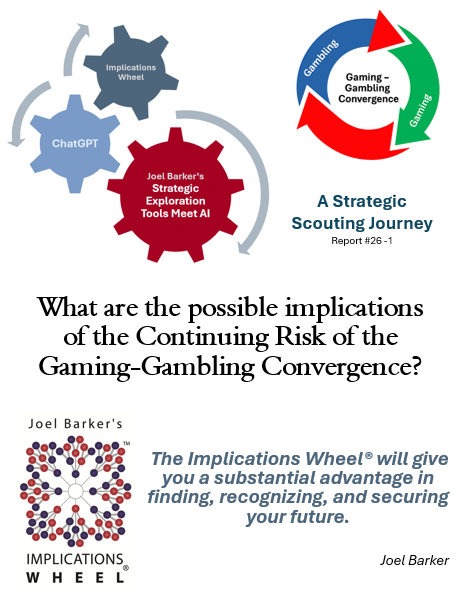
Gaming - Gambling Convergence
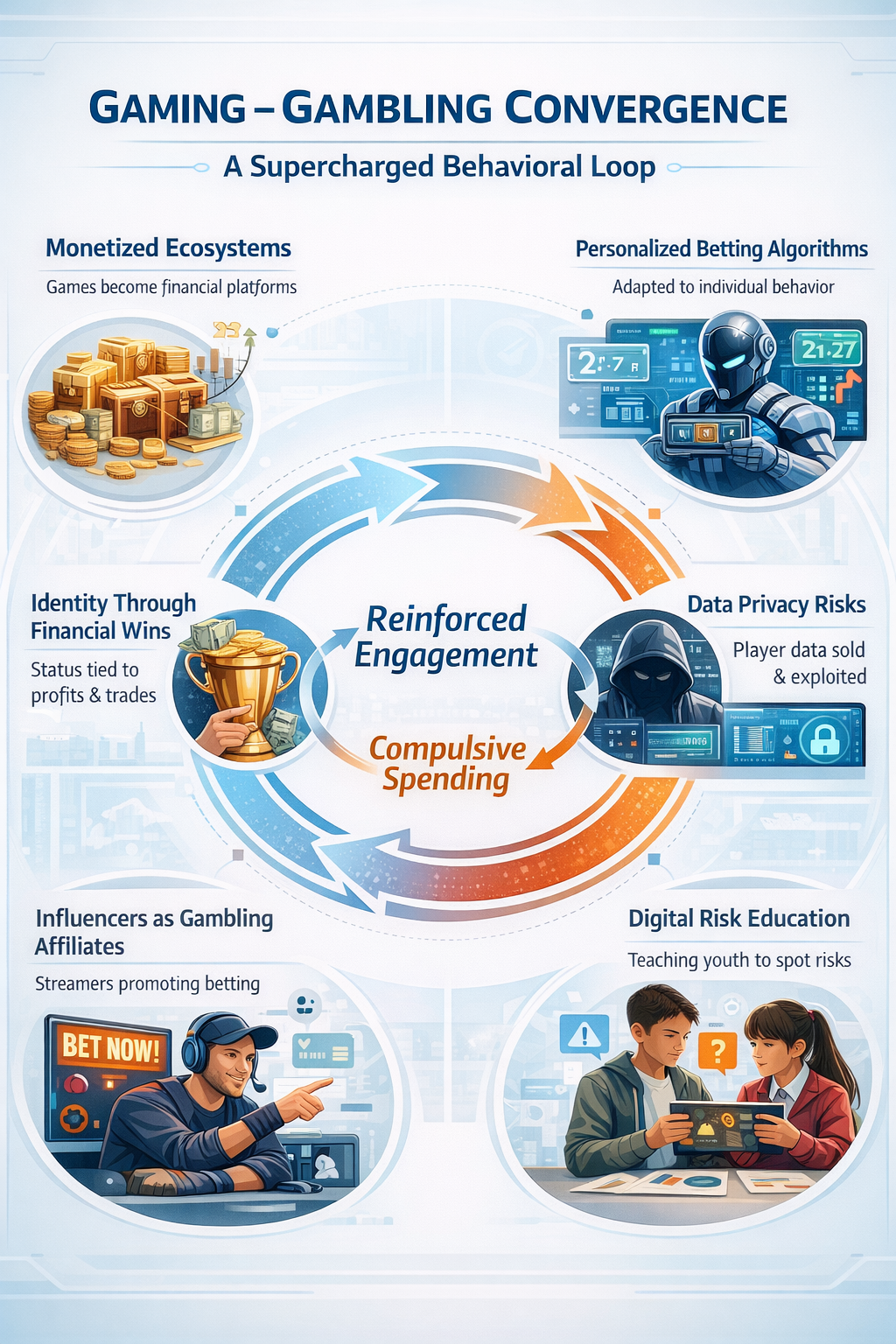
Gaming - Gambling Convergence Bahavioral Loop
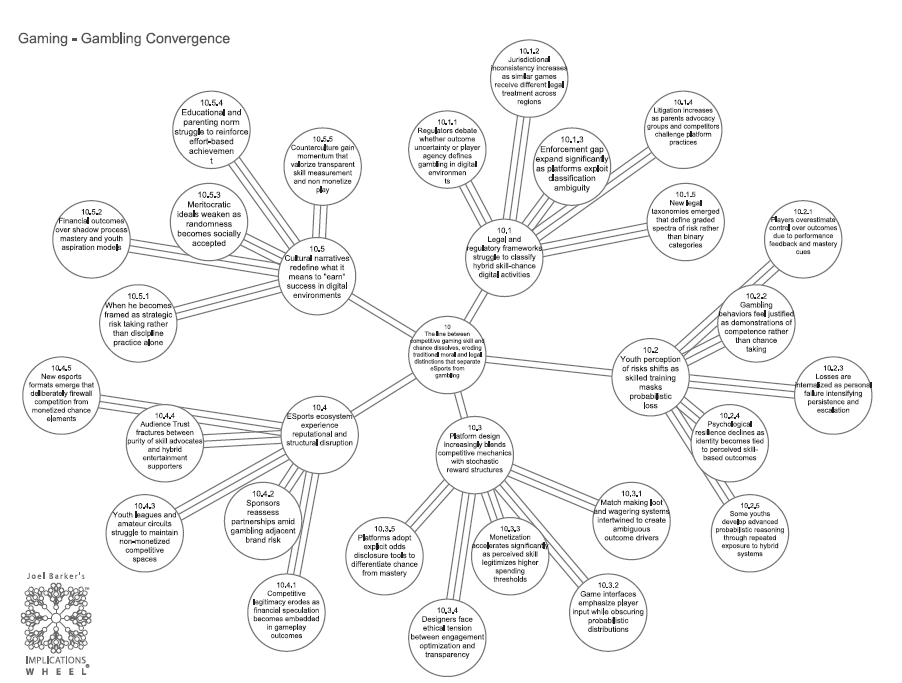
Gaming-Gambling Convergence Arc
Implications Wheel analysis highlights youth exposure, AI-driven behavioral loops, and perception gaps between parents and young people
The Implications Wheel will give you a substantial advantage in finding, recognizing, and securing your future.”
MILWAUKEE, WI, UNITED STATES, January 12, 2026 /EINPresswire.com/ -- A new strategic report examining the accelerating convergence of online gaming and online gambling warns that emerging digital entertainment ecosystems are reshaping how risk, reward, and financial behavior are experienced, particularly by youth and young adults. The report, What Are the Possible Implications of the Continuing Risk of the Gaming–Gambling Convergence? applies Joel Barker’s Implications Wheel® and related Strategic Exploration Tools, enhanced by purpose-built generative AI, to explore the second- and third-order consequences of this rapidly evolving trend.— Joel Barker
The report identifies a paradigm shift in digital engagement: gambling is increasingly embedded within game-like environments that compress decision–reward cycles, obscure financial risk, and normalize speculative behavior. Features such as micro-betting, gamification, influencer promotion, loot-box mechanics, and AI-driven personalization are no longer peripheral innovations; together, they form what the report describes as a “supercharged behavioral loop” that blends play, competition, monetization, and chance.
“Historically, gaming and gambling were regulated, understood, and experienced as distinct activities,” the report notes. “That boundary is now increasingly porous, creating hybrid engagement models that demand new forms of foresight, policy, education, and leadership.”
A Strategic Scouting Journey Using the Implications Wheel®
The analysis is structured as a “12-2-60 Scouting Journey,” an example of the Implications Wheel® methodology. The exploration begins with a carefully defined “center” describing the accelerating convergence of online gaming and online sports gambling. From that center, the study identifies twelve first-order implications, followed by multiple arcs of second- and third-order consequences, resulting in interconnected implications that extend across youth development, public health, regulation, industry design, and workplace culture.
Unlike traditional forecasting approaches, the Implications Wheel® emphasizes structured imagination, multiple stakeholder perspectives, and disciplined “what-if” thinking. In this report, generative AI tools were trained specifically on Joel Barker’s Strategic Exploration framework and used to generate implications, scoring rationales, and perception-gap analyses—demonstrating how AI can augment, rather than replace, expert-led foresight.
Key Findings: Youth, Platforms, and Regulation
Among the most significant findings is the role of early exposure. The report highlights how many young people encounter gambling-like mechanics not through casinos or sportsbooks, but through video games, streaming platforms, and social entertainment. Loot boxes, virtual economies, and chance-based rewards introduce probabilistic outcomes and variable reinforcement long before the legal gambling age, potentially conditioning users to financial risk behaviors later in life.
The report also documents the rapid rise of micro-betting, ultra-fast wagers that resolve in seconds, and notes how closely these mechanics mirror the feedback loops of mobile games. By framing betting as a moment-to-moment interaction rather than as discrete financial decisions, platforms may increase engagement while obscuring risk.
The report concludes that regulatory frameworks have struggled to keep pace. Gaming and gambling laws were developed for earlier eras with clearer product boundaries, leaving today’s hybrid models in regulatory gray zones. Definitions such as “money or money’s worth,” indirect cash-out mechanisms, and influencer-driven promotion vary widely across jurisdictions, creating exploitable seams that complicate oversight and harm-reduction efforts.
Perception Gaps: Parents vs. Youth
One of the report’s most striking contributions is a detailed perception-gap analysis comparing how parents and students view the same implications. Using desirability and likelihood scoring, the study reveals systematic differences in interpretation.
Youth participants tend to view monetized gaming platforms and immersive experiences as normal, or even exciting, while parents overwhelmingly perceive them as exploitative and dangerous. Conversely, parents strongly support regulatory and educational interventions, while students often experience these measures as restrictive or intrusive. These gaps, the report argues, are not merely attitudinal; they represent a critical challenge for policymakers, educators, and prevention efforts seeking to communicate risk effectively across generations.
Beyond Youth: Workplace and Organizational Impacts
The report extends its analysis into the workplace, identifying how digitally conditioned reward systems may influence employee attention, productivity, financial stress, and organizational culture. Potential implications include increased attention fragmentation, rising absenteeism linked to gambling losses, ethical challenges around workplace betting pools, and the inadvertent replication of addictive mechanics in gamified learning and performance systems.
At the same time, the report identifies opportunities: workplace wellness programs that include digital risk literacy, leadership training focused on algorithmic persuasion, and AI-assisted early-warning systems, if deployed ethically, could help organizations adapt to these emerging realities.
Implications for Leaders and Decision-Makers
Rather than offering predictions, the report provides what it calls “decision-enhancing information.” By mapping multiple plausible futures and scoring them from the perspectives of youth, parents, educators, industry, regulators, and employers, the analysis equips leaders to recognize emerging risks earlier and respond more thoughtfully.
The report also demonstrates the growing potential of generative AI as a foresight partner. When guided by disciplined frameworks like the Implications Wheel®, AI can accelerate exploration, surface perception gaps, and support richer discussion—while still requiring human facilitation, judgment, and ethical oversight.
Availability
What Are the Possible Implications of the Continuing Risk of the Gaming–Gambling Convergence? is part of a series of Strategic Scouting Journey reports exploring emerging societal, technological, and economic trends using Joel Barker’s Strategic Exploration Tools. The report is intended for leaders in education, public health, policy, technology, human resources, and community development who are responsible for navigating complex, fast-moving change.
James Schreier
Strategic Exploration Consultant
+1 414-828-0856
email us here
Legal Disclaimer:
EIN Presswire provides this news content "as is" without warranty of any kind. We do not accept any responsibility or liability for the accuracy, content, images, videos, licenses, completeness, legality, or reliability of the information contained in this article. If you have any complaints or copyright issues related to this article, kindly contact the author above.
