

Bifacial Solar Market to Grow at 13.6% CAGR: Demand Rises for Dual-Sided High-Efficiency Panels
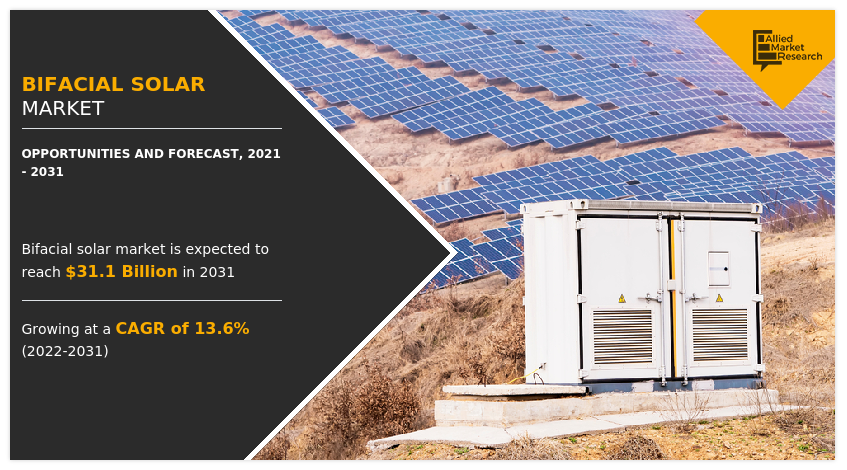
Bifacial Solar Market Surges to $31.1 Billion by 2031 | High-Efficiency Modules Power Global Growth
The bifacial solar market is set to reach $31.1B by 2031, driven by high-efficiency dual-sided panels, rising solar adoption, and global clean energy goals.”
WILMINGTON, DE, UNITED STATES, December 11, 2025 /EINPresswire.com/ -- — Allied Market Research
The bifacial solar market is witnessing rapid global expansion as industries, governments, and consumers shift toward more efficient and cost-effective solar technologies. According to a recent report by Allied Market Research, the global bifacial solar market was valued at $8.7 billion in 2021 and is projected to reach $31.1 billion by 2031, growing at a strong CAGR of 13.6% from 2022 to 2031. This remarkable growth reflects increasing adoption of dual-sided solar modules, supportive government policies, and rising demand for cleaner electricity across residential, commercial, and industrial sectors. 🌍⚡
Download PDF Brochure: https://www.alliedmarketresearch.com/request-sample/A16957
🌞 What Makes Bifacial Solar Panels Different?
Bifacial solar panels are an advanced solar technology engineered with solar cells on both sides of the module. This design allows panels to generate electricity from both the front and rear surfaces, capturing direct sunlight as well as reflected and diffused light. These panels often produce up to 30% more energy compared to traditional monofacial panels, depending on installation conditions.
Key advantages include:
⚡ Higher energy output in the same footprint
🔋 Lower Levelized Cost of Energy (LCOE)
💡 High durability with UV-resistant coatings on both sides
🏭 Reduced balance-of-system (BOS) costs
❌ Lower risks of Potential-Induced Degradation (PID), especially in frameless designs
These benefits make bifacial solar panels ideal for commercial, industrial, and utility-scale solar projects where maximizing output and efficiency is essential.
🔋 Rising Global Demand for Solar Electricity Fuels Market Growth
The surge in demand for solar power is one of the primary drivers of the bifacial solar market. Industries and commercial establishments increasingly rely on solar energy to offset peak power usage, reduce energy costs, and meet sustainability targets.
Organizations worldwide are adopting high-efficiency solar modules that offer better performance and long-term savings. As solar technology becomes more affordable and efficient, bifacial modules are emerging as the preferred choice for energy-intensive sectors.
Additionally, the rapid expansion of solar parks, rooftop installations, and industrial energy management systems is further boosting market demand. This trend is expected to continue as companies focus on reducing operational costs and enhancing energy independence.
🌱 Government Policies Boost Adoption of Bifacial Solar Technology
Government incentives and renewable energy policies play a significant role in expanding the bifacial solar market. One key example is the Feed-in Tariff (FiT) initiative, where governments pay consumers for the solar electricity they generate. These incentives help reduce installation costs and encourage adoption of solar technologies.
In Europe, the European Green Deal has significantly accelerated renewable energy deployment. The initiative aims to cut carbon emissions and promote mass adoption of solar energy across residential and commercial buildings. 🌿
In rural regions globally, governments have also launched programs to support electrification using renewable energy, making solar-powered solutions more accessible and affordable.
⚡ Technological Advancements Accelerate Market Expansion
The bifacial solar market continues to evolve with ongoing advancements in materials, solar cell structures, and panel design. Manufacturers are investing heavily in research and development to reduce the cost of bifacial modules while increasing power output and lifespan.
Some of the key technological innovations include:
High-efficiency Heterojunction Technology (HJT) cells
Passivated Emitter Rear Cell (PERC) technology, the leading segment in 2021
Frameless module designs to eliminate PID risks
Advanced glass-glass configurations for enhanced durability
These innovations help improve electricity generation, reduce energy losses, and lower installation costs—making bifacial solar panels more attractive for large-scale applications.
Buy This Report (300 Pages PDF with Insights, Charts, Tables, and Figures): https://www.alliedmarketresearch.com/checkout-final/d6672e611f073a705eb7ae0c5250c070
🌍 Global Market Segmentation Overview
The bifacial solar market is segmented based on cell type, frame type, end use, and region.
📌 By Cell Type
Passivated Emitter Rear Cell (PERC) – Dominated the market in 2021 due to high efficiency and larger-scale adoption
Heterojunction Cell (HJT) – Expected to grow due to superior performance in low-light environments
📌 By Frame Type
Framed bifacial modules – Leading in 2021 due to ease of installation and durability
Frameless modules – Preferred for reducing PID risks
📌 By End Use
Industrial – Highest revenue contributor in 2021
Commercial – Growing rapidly due to higher electricity requirements
Residential – Expanding in rooftop solar markets
📌 By Region
Europe – Largest market in 2021, driven by strong renewable energy policies
North America – Rapidly growing due to solar incentives and industrial adoption
Asia-Pacific – Significant growth expected due to rising urbanization and demand for clean energy
LAMEA – Emerging markets adopting solar to support rural electrification
🏢 Key Players Driving Global Competition
Major companies leading the bifacial solar market include:
Jinko Solar Holdings
Canadian Solar
Yingli Green Energy
LG Electronics
LONGi
JA Solar Holding Co. Ltd.
Trina Solar
Sharp Corporation
SunPower Corporation
Wuxi Suntech Power Co., Ltd.
These companies focus on capacity expansion, partnerships, acquisitions, and technology innovation to strengthen their global market presence.
🦠 Impact of COVID-19 on the Bifacial Solar Market
The COVID-19 pandemic adversely affected the bifacial solar market due to:
🚚 Disruptions in global raw material supply chains
🏭 Shutdown of manufacturing plants
👷 Reduced labor availability
🏗️ A decline in commercial construction and tourism-related projects
However, the market recovered quickly in late 2021 as industries resumed operations and governments prioritized clean energy investment as part of economic recovery plans.
Get a Customized Research Report: https://www.alliedmarketresearch.com/request-for-customization/A16957
🌞 Conclusion
The bifacial solar market is set for remarkable growth over the next decade, driven by rising clean energy demand, strong government support, innovative solar technologies, and increasing adoption across industrial and commercial sectors. With its ability to generate energy from both sides and deliver higher efficiency, bifacial technology is shaping the future of solar energy worldwide. As global energy transition accelerates, bifacial solar panels will play a key role in building a sustainable, low-carbon future. 🌍💡⚡
Trending Reports in Energy and Power Industry:
Bifacial Solar Market
https://www.alliedmarketresearch.com/bifacial-solar-market-A16957
Solar Charge Controller Market
https://www.alliedmarketresearch.com/solar-charge-controller-market-A09304
Solar Simulator Market
https://www.alliedmarketresearch.com/solar-simulator-market-A16503
Solar Charger Market
https://www.alliedmarketresearch.com/solar-charger-market-A64817
Solar Energy Market
https://www.alliedmarketresearch.com/solar-energy-market
Solar Generator Market
https://www.alliedmarketresearch.com/solar-generator-market-A12890
Solar Street Lighting Market
https://www.alliedmarketresearch.com/solar-street-lighting-market-A07227
Solar Control Window Films Market
https://www.alliedmarketresearch.com/solar-control-window-films-market
Solar Cell and Module Market
https://www.alliedmarketresearch.com/solar-cell-and-module-market-A207453
Solar Photovoltaic Glass Market
https://www.alliedmarketresearch.com/solar-photovoltaic-glass-market
Renewable Energy Market
https://www.alliedmarketresearch.com/renewable-energy-market
Distributed Energy Generation Market
https://www.alliedmarketresearch.com/distributed-energy-generation-market-A13784
Clean Energy Infrastructure Market
https://www.alliedmarketresearch.com/clean-energy-infrastructure-market-A323711
Clean Energy Market
https://www.alliedmarketresearch.com/clean-energy-market-A43785
Concentrated Solar Power Market
https://www.alliedmarketresearch.com/concentrated-solar-thermal-market
About Us
Allied Market Research (AMR) is a full-service market research and business-consulting wing of Allied Analytics LLP based in Portland, Oregon. Allied Market Research provides global enterprises as well as medium and small businesses with unmatched quality of "Market Research Reports" and "Business Intelligence Solutions." AMR has a targeted view to provide business insights and consulting to assist its clients to make strategic business decisions and achieve sustainable growth in their respective market domain.
Pawan Kumar, the CEO of Allied Market Research, is leading the organization toward providing high-quality data and insights. We are in professional corporate relations with various companies and this helps us in digging out market data that helps us generate accurate research data tables and confirms utmost accuracy in our market forecasting. Each and every data presented in the reports published by us is extracted through primary interviews with top officials from leading companies of domain concerned. Our secondary data procurement methodology includes deep online and offline research and discussion with knowledgeable professionals and analysts in the industry.
David Correa
Allied Market Research
+ + + + + + + + + + + + +1 800-792-5285
email us here
Visit us on social media:
LinkedIn
Facebook
YouTube
X
Legal Disclaimer:
EIN Presswire provides this news content "as is" without warranty of any kind. We do not accept any responsibility or liability for the accuracy, content, images, videos, licenses, completeness, legality, or reliability of the information contained in this article. If you have any complaints or copyright issues related to this article, kindly contact the author above.
