

Your daily news update on Europe
Provided by AGP
Anton Bonifacio Explains AI Success Depends on Cybersecurity & Scale on the CAIO Connect Podcast with Sanjay Puri

CAIO Connect Podcast
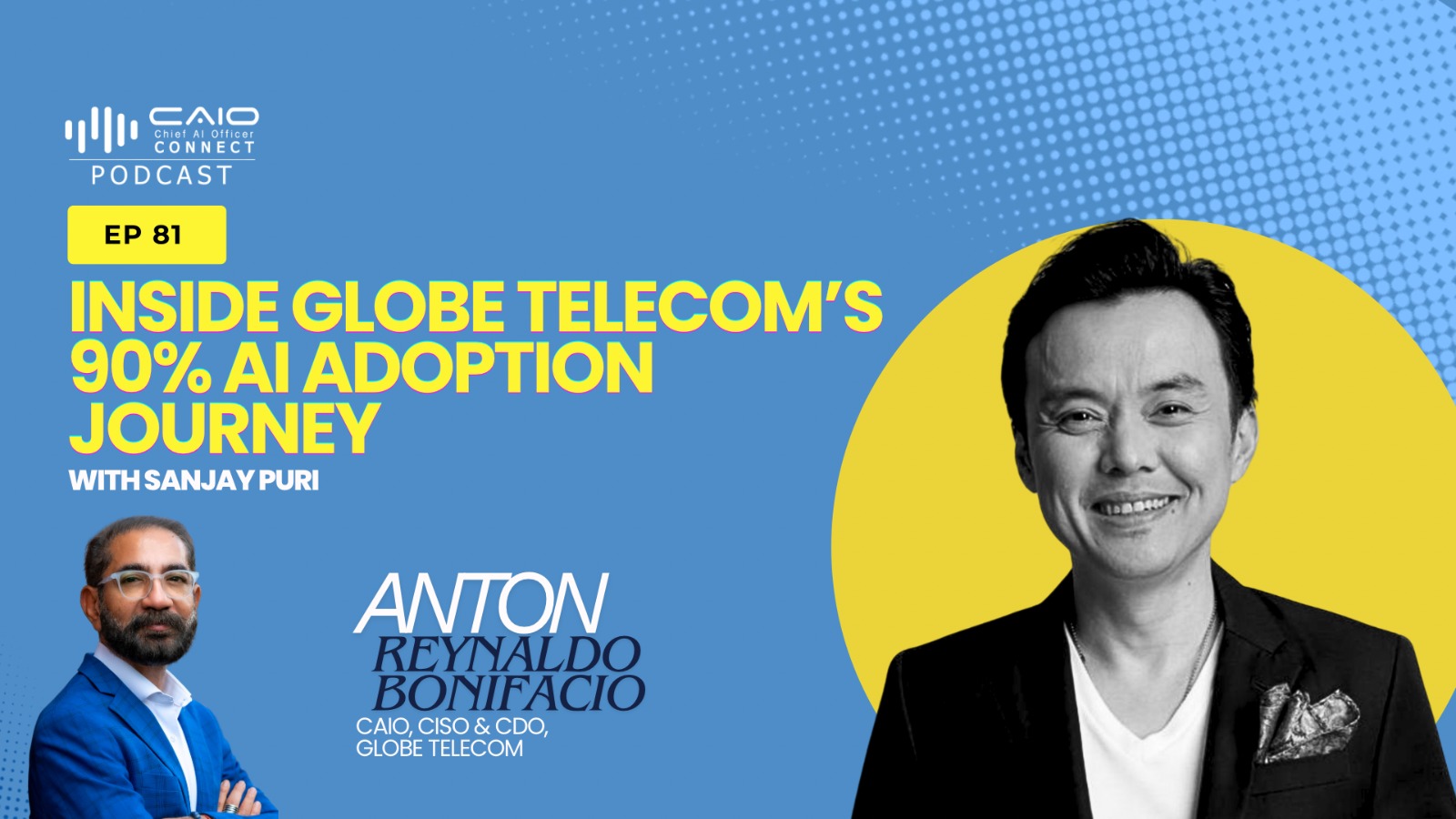
Anton Bonifacio, Chief AI Officer, Chief Information Security Officer, and Chief Data Officer at Globe Telecom with Sanjay Puri, President of CAIO Connect
Globe Telecom’s Anton Bonifacio told Sanjay Puri’s CAIO Connect Podcast that AI growth must pair with cybersecurity, governance, and scale.
Responsible AI should not become a gate that slows everything down.”
WASHINGTON, DC, UNITED STATES, May 11, 2026 /EINPresswire.com/ -- At the CAIO Connect Podcast during a wide-ranging discussion hosted by Sanjay Puri, Anton Reynaldo Bonifacio explained why companies cannot separate artificial intelligence from cybersecurity. Bonifacio, who leads AI, security, and data strategy at Globe Telecom, said organizations must treat AI adoption and cyber defense as one connected mission. He warned that companies moving too slowly on AI risk falling behind, while companies ignoring security create larger risks for customers and operations.— Anton Reynaldo Bonifacio
Bonifacio described Globe Telecom as one of the Philippines’ largest telecom providers, serving roughly 57 million mobile users in a highly digital market. He also highlighted the company’s role in helping launch digital services such as GCash, which now reaches millions of Filipinos. During the interview, he explained how his career started at age 12 as one of the Philippines’ youngest bulletin board system operators before the internet became mainstream. That early curiosity, he said, taught him to “catch the waves” of major technology shifts. He later moved into Linux, cybersecurity, consulting, and eventually enterprise AI leadership. Bonifacio argued that leaders must position themselves early around emerging technologies instead of waiting for trends to mature.
A major focus of the conversation centered on Globe Telecom’s unusual decision to combine AI, cybersecurity, and data leadership under one executive role. Bonifacio said the company’s leadership believed early that “you can’t do AI if you don’t do cyber.” He explained that AI systems cannot scale safely without strong governance, privacy controls, and security foundations. According to Bonifacio, Globe Telecom now has AI adoption across roughly 90% of its workforce. Employees use AI not only for chat tools but also to build internal copilots, automation systems, and workflow agents. Many of these projects come from nontechnical teams such as finance and marketing. Bonifacio said the company encouraged a bottom-up strategy that allowed employees closest to business problems to design their own AI solutions.
The interview also explored the growing risks tied to agentic AI and enterprise automation. Bonifacio warned that the speed of AI innovation now moves faster than many governance and security systems can handle. He said organizations face rising concerns around prompt injection, rogue agents, and endpoint-based AI tools that traditional cybersecurity products may not fully cover. Still, he stressed that companies with strong cybersecurity “hygiene” already possess an important advantage. Identity management, visibility, observability, and access controls remain critical defenses even in the age of AI agents. Bonifacio also noted that businesses should not wait for regulators to define every rule. Instead, he urged risk leaders and chief information security officers to experiment carefully, move faster, and “get ahead of the curve” before threats become larger.
Bonifacio also challenged traditional thinking around AI return on investment. He argued that companies should initially treat AI adoption more like a startup growth phase instead of demanding immediate profits. During Globe Telecom’s first 18 months of AI deployment, leadership focused almost entirely on employee adoption and experimentation. Rather than forcing a central AI team to define all use cases, Globe allowed departments to create their own solutions. Bonifacio said this strategy helped build “fertile soil” for future large-scale AI transformation projects. Only after strong adoption did the company begin focusing heavily on ROI, token costs, and enterprise scaling decisions.
Toward the end of the CAIO Connect Podcast conversation, Bonifacio emphasized that responsible AI cannot operate as a bottleneck. He said Globe Telecom shifted toward “self-service governance,” where employees receive tools and guidance that help them secure and govern their own AI systems. He also stressed that physical and mental health play an important role in handling multiple leadership responsibilities across AI, security, and data. In a rapid-fire closing segment with host Sanjay Puri, Bonifacio strongly backed open-source technology, production-ready AI agents, and broad AI access for employees. His message to enterprise leaders remained clear throughout the discussion: companies that combine AI scale with cybersecurity discipline will shape the next phase of global digital transformation.
Upasana Das
Knowledge Networks
email us here
Visit us on social media:
LinkedIn
Instagram
Facebook
YouTube
X
Legal Disclaimer:
EIN Presswire provides this news content "as is" without warranty of any kind. We do not accept any responsibility or liability for the accuracy, content, images, videos, licenses, completeness, legality, or reliability of the information contained in this article. If you have any complaints or copyright issues related to this article, kindly contact the author above.
